A Google Business Profile for audiologists should help someone find the right hearing-care clinic, understand what happens at a first visit, and reach a real appointment route. Getting there starts with an accurate business listing—not extra keywords in the name, daily promotional posts, or a promise that every edit will move you into the map pack.
Imagine an adult daughter trying to arrange a hearing evaluation for her father. She finds two nearby practices on Google Maps. One has accurate hours, an exterior photo she can recognize, a clear list of services, and an appointment page that works on mobile. The other has an outdated phone number and no explanation of what to book. Even if both appear in search, they do not offer the same experience. This guide walks through the decisions that turn a profile into a useful path to care.
If your clinic is also weighing referrals, educational content and other channels, start with our audiology marketing ideas guide. This article focuses on the Google Business Profile itself.
Audiology Google Business Profile Checklist: Find the First Problem
Open Google Maps and search for your exact practice name and city before editing anything. The right first action depends on what you find:
| What you see | Start here | Proof that the fix worked |
| No listing for the exact clinic name | Check whether the business already exists under an old name; assess eligibility, ownership and verification. | A correctly named eligible profile can be viewed publicly. |
| A listing that someone else controls | Request ownership; do not create a second profile simply to regain control. | Approved owner or manager can edit the original profile. |
| Your name appears, but “audiologist near me” does not | Verify categories and actual services, then compare results across locations. | Relevant fields are accurate; track local visibility without assuming an instant rank change. |
| People click, but appointments do not arrive | Test phone, mobile website, location-specific booking page and intake handling. | A real test enquiry reaches the right team; booked appointments are tracked separately. |
Google says local rankings mainly reflect relevance, distance and prominence. There is no paid shortcut to a higher organic local position. Completeness helps Google understand the business, but proximity and competition still matter.
Source: Google’s local ranking guidance.
Who Is Eligible for a Hearing Clinic Google Business Profile?
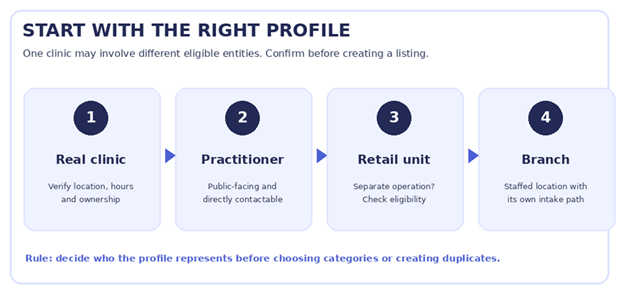
Before you create a profile, answer one question: what real-world business—or eligible individual professional—does this listing represent? An online-only advice site is not a substitute for a staffed, in-person clinic. A hearing-aid brand carried by a clinic is not a separate business merely because it has a product page.
Single Audiology Practice, Practitioner, or Hearing Aid Retailer?
| Entity | Practical eligibility check | Common mistake |
| Audiology practice | Real business identity, patient-facing location and staff during stated hours. | Creating a second profile for each service line. |
| Individual audiologist | Public-facing provider who can be contacted directly at the verified location; Google’s practitioner rules apply. | Making profiles for every employee or specialization. |
| Hearing aid retail operation | A genuinely distinct retail business, not simply products sold by the clinic. | Creating a duplicate “Hearing Aid Store” listing at the same address. |
| Second clinic branch | An eligible, staffed location with accurate hours and intake details. | Listing an unstaffed or virtual address as a real clinic. |
For a solo branded practice, Google generally recommends sharing one listing with the sole public-facing practitioner. Where several eligible practitioners work at one clinic, separate practitioner profiles may be allowed if the rules are met. Do not interpret that permission as an instruction to make more listings.
Check the exact rules before creating profiles: Google’s business representation guidelines.
How to Claim and Verify a Google Business Profile for Audiologists
Claim an Existing Audiology Clinic Listing Before Adding Another
- Search the practice name, old trading names, street address and main phone number in Google Maps. Inspect listings for former owners or previous locations.
- If the correct profile exists, select the claim or management option. If someone else owns it, use Google’s ownership-request process rather than rebuilding the profile.
- If no eligible profile exists, add the real business through Google Business Profile. Enter the name used on signs and business records; do not append “best audiologist near me” or neighboring-city keywords.
- Use a business-owned account for primary control, then add the clinic’s internal manager or authorized agency with appropriate access.
Verify Your Hearing Clinic Using the Method Google Offers
Google chooses which verification methods to display. Depending on the profile, it may offer video, phone, email, postcard or another route, and it can ask for more than one method. Follow the option shown—there is no legitimate way to force a preferred method.
For video verification, prepare a short, continuous recording that can show exterior signage, the real location, clinic equipment and evidence that you manage the premises, as requested. Avoid revealing patient records, identifiable charts or active treatment conversations. If verification fails, review the specific request and appeal or re-verify through the official flow. Publishing another blog will not correct a suspended profile.
Official steps: Add or claim a Business Profile · Verify your business.
Audiologist or Hearing Aid Store: Choose the Right Google Business Category
Google category selection describes what the business is, not every service or brand it offers. For an established diagnostic audiology practice, “Audiologist” may be the most accurate primary category when that option is available. For a genuine hearing-aid retail business, “Hearing Aid Store” may better describe the core function. Choose from the categories shown in the live picker and avoid unrelated extras.
| Your actual business | Candidate primary category | What to verify |
| Clinic primarily provides audiological evaluation and professional care | Audiologist | The clinic actually delivers the clinical services promoted and is appropriately staffed. |
| Distinct business primarily sells and fits hearing aids | Hearing Aid Store | That entity is genuinely retail-led, eligible and not a duplicate of the clinic profile. |
| A practice does both | Category matching its primary business identity | Do not choose on the basis of one lucrative keyword; consider the whole operation. |
| Public-facing individual provider | Practitioner category available to that professional | Individual profile eligibility and direct contact at the verified location. |
To review a category, open the verified profile, select Edit profile, then locate Business category. Changing it can trigger verification or review. Do not repeatedly flip categories to test rankings without a real change in business identity.
Optimize Audiology Business Details Patients Actually Check
Many GBP audits start with keywords. A better first pass is the information a person needs before they feel comfortable booking. Each field below should be verified against the actual clinic—not a competitor’s listing.
| Profile field | Patient-centered editing rule |
| Business name | Use the real branded name; no promotional adjectives or keywords added solely for ranking. |
| Address and map pin | Match the actual staffed entrance; confirm directions lead visitors to the correct reception. |
| Phone | Use a reachable clinic number; test calling from a mobile device during stated hours. |
| Regular and special hours | Show reception availability accurately; add holiday or temporary closures promptly. |
| Website | Link to a mobile-friendly page that explains the practice and links to the correct services. |
| Appointment path | Send people to a working booking form or contact route for that exact clinic, if the link feature is eligible. |
| Accessibility and amenities | Only state entrance, parking, communication or mobility accommodations you have personally confirmed. |
Two easy-to-miss details: first, practice hours may differ from an individual clinician’s appointment schedule. Second, a working phone number does not guarantee that anyone answers it or returns missed calls. Include an actual contact test in the audit.
How to Add Hearing Tests, Hearing Aid Fittings and Other Audiology Services
A service list is useful only when it reflects services available at that location. Patients may search for “hearing test near me,” “hearing aid fitting,” or “tinnitus evaluation,” but these phrases must not be used to advertise care your clinic cannot deliver. Ask the clinical team to approve each service name and a plain-language explanation.
| Service label candidate | Useful patient explanation |
| Hearing evaluations | Who may need an assessment, what to expect, and how to request an appointment. |
| Hearing aid consultation | How assessment and device discussions work; do not promise a specific device or outcome. |
| Hearing aid fitting and follow-up | Explain that fitting and follow-up depend on the practice’s actual care process. |
| Tinnitus evaluation | Describe what the clinic assesses if this service is genuinely offered. |
| Pediatric audiology | Only include if qualified staff and appropriate appointments are available. |
| Balance or vestibular assessment | Include only where the location has the relevant clinical capability. |
Do not create a profile category for every procedure, copy a competitor’s services wholesale, or make claims about insurance coverage without current verification. If the interface does not offer a field for a particular service, put accurate information on the clinic website rather than misusing a different field.
Write an Audiology Google Business Profile Description That Builds Confidence
The business description has a 750-character limit. It should answer what the practice does, whom it serves and what makes the visit manageable—not advertise a special offer or repeat “audiologist near me” ten times.
Fictional example — edit every claim before using:
“Willow Hearing Clinic provides adult hearing evaluations, hearing aid consultations and follow-up appointments in a welcoming clinic setting. Our team explains appointment steps clearly and helps patients understand available hearing-care options. Contact the clinic to confirm current services, opening hours and appointment availability.”
Why this works: it identifies the practice type, names plausible services and gives the reader a next action without invented awards, guarantees, prices or medical outcomes. A real profile should use the practice’s verified identity, service mix and location details.
For current edit instructions and the 750-character rule, see Google’s Business Profile description guidance.
Use Audiology Clinic Photos, Access Details and Appointment Links
Choose Hearing Clinic Photos That Reduce First-Visit Uncertainty
A visitor may be worried about finding the door, understanding the appointment, or knowing whether a parent can get in comfortably. Photos can answer those practical questions more effectively than a generic stock image. Start with the exterior and entrance, reception, a clean consultation space, and authorized staff photographs. Add equipment only where the image accurately reflects the clinic.
Never upload identifiable patient images without valid permission. Avoid showing test results on monitors, appointment schedules, personal files or clinic records. Use clear, current photographs rather than heavily edited images. Google’s Business Profile photo requirements are separate from this article’s compressed editorial graphics.
For broader image accessibility and search fundamentals, see whether adding more pictures improves SEO.
Make the Audiology Appointment Link Work for Every Location
If Google offers the booking-link feature to your business and region, choose a direct destination for that clinic. The page should state the service, location, available next steps and whether the visitor is requesting an appointment or confirming one. Test the process on a phone, including confirmation and response time. For multi-location practices, do not send every branch to a generic calendar without location context.
Some appointment features and third-party providers differ by country, category and provider. If the option is unavailable, make your website and phone route reliable rather than inventing a workaround.
See Google’s business link guidance for current availability and setup.
Google Reviews for Audiologists: Request Feedback Without Exposing Patient Details
A genuine review can help prospective patients decide whether a clinic feels trustworthy. But healthcare reviews require a stricter process than ordinary retail feedback. The practice should use a uniform, voluntary request approach, not just ask satisfied patients or offer incentives for a five-star rating.
A Neutral Hearing Clinic Review Request Example
“If you would like to share your experience with our practice, you can leave an honest Google review using this link. Your feedback is optional. Please avoid including private medical information in a public review.”
Send a request only through a practice-approved channel. Do not pressure someone to review on the premises, ask them to name a clinician, or condition any service on public feedback.
Privacy-Safe Public Responses to Audiology Reviews
Example public response to positive feedback: “Thank you for taking the time to share feedback. We appreciate hearing from people in our community.”
Example public response to a complaint: “Thank you for sharing your concerns. Please contact our office directly so the appropriate team member can review the matter privately.”
Do not confirm the reviewer is a patient, identify a device, discuss appointment dates, repeat a diagnosis or disclose treatment details—even when the reviewer volunteers information publicly. In the US, the practice should have privacy counsel or its designated HIPAA compliance lead approve templates and workflows; other countries have their own privacy requirements.
Review policy: Google’s prohibited and restricted review content rules.
Connect Your Audiology Business Profile to the Right Website Pages
A completed profile is only the first step. If someone clicks through to your website, the destination must confirm that the clinic provides the service they were looking for and show how to get help. Do not make users decipher a generic home page when they are trying to book a hearing evaluation.
For one clinic, a well-structured location page can explain the address, clinicians, approved services, accessibility, hours and contact options. For two branches, each genuinely different location needs accurate local details and its own routing. Separate service pages make sense when the practice provides those services and they deserve their own explanation; duplicate city pages written only to repeat keywords do not.
SEO Findings explains how website structure, relevant service pages and local visibility work together in its hearing aid SEO services guide. An initial review can identify the highest-impact issue before paid work is proposed.
The website should also display a real business identity, trustworthy authorship or clinical review where medical guidance is involved, and clear information about what the practice does. This is especially important when patients are using search results or AI tools to compare care options.
Why an Audiology Practice Is Not Showing on Google Maps
The phrase “not showing on Google” can describe three different problems: the listing does not appear for its own name; it appears for the name but not for nearby service queries; or it appears near the clinic but less often across the broader market. Each requires different evidence.
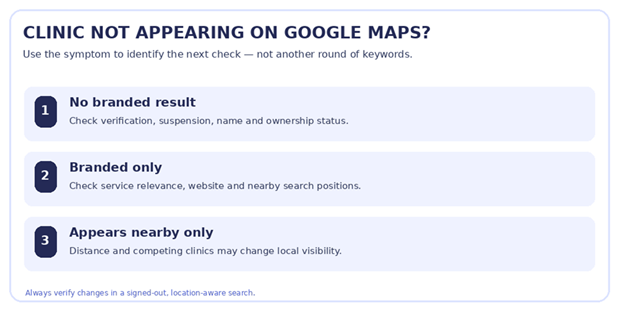
| Symptom | Check | Next sensible action |
| Exact practice name returns nothing | Profile ownership, verification status, suspension/disablement, old name. | Follow the platform’s verification or appeal route. |
| Practice appears by name but not “hearing tests near me” | Business category, actual services, location page, local competition. | Correct genuine business information and test from relevant search locations. |
| High near clinic, low in another neighborhood | Searcher distance, local competitor prominence and query relevance. | Measure geographically; do not promise to win every radius. |
| Wrong phone / pin / booking URL | Profile fields and real website redirects. | Correct the field and test the public listing. |
| Multiple similar clinic listings | Entity identity, old businesses and legitimate practitioner profiles. | Assess under Google policy before merging or reporting anything. |
Some changes take time to be reviewed and reflected publicly. There is no official “post three times per week to fix your Maps rank” shortcut. Publishing a new article cannot resolve a GBP verification suspension.
How to Track Google Business Profile Results and Real Appointments
Google Business Profile performance can report profile views, searches, call-button clicks, website clicks and direction requests. These are signals of interest, not proof that a phone conversation occurred or a patient booked. For participating eligible booking systems, booking metrics may be available, but clinics still need to reconcile them with actual intake records.
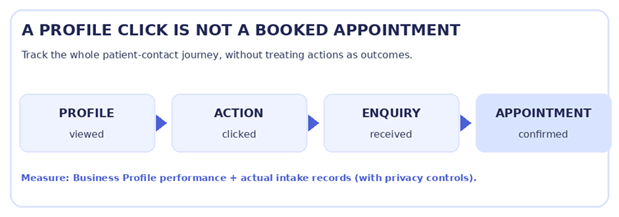
A Practical Audiology GBP Measurement Sheet
| Measure | Where to get it | How to interpret it |
| Business Profile views | Google Business Profile Performance | The profile was viewed; not a website visit or patient. |
| Call-button clicks | Google Business Profile Performance | Someone tapped a call action; not necessarily a completed call. |
| Website visits from GBP | Tagged profile link + GA4 where configured | Traffic from the profile; not an appointment. |
| Qualified enquiries | Clinic intake / CRM, privacy-safe source field | Requests that match the clinic’s services and locations. |
| Booked appointments | Practice scheduling record | Confirmed bookings; track reschedules and cancellations separately. |
Illustrative workflow, not client performance data: if a clinic records 20 GBP call-button clicks, that is 20 button interactions—not 20 conversations or 20 appointments. A basic privacy-safe intake log could record the originating channel, location, general enquiry category and whether an appointment was scheduled, without exporting protected health information into marketing dashboards.
Metric definitions: Google Business Profile performance help.
A 30-Day Google Business Profile Audit for Audiology Practices
Treat this as an operations checklist, not a promised ranking timetable. Complete the highest-risk accuracy problems first.
| When | Task | Completion evidence |
| Days 1–5 | Confirm eligibility, ownership, verification and the real business identity. | Admin access and a publicly accurate listing. |
| Days 6–12 | Audit category, actual services, address, phone, hours, accessibility and booking route. | Field checklist approved by the clinic; test contact reaches staff. |
| Days 13–20 | Review approved photos, review-request language, privacy response process and website matching. | Current media, reviewed scripts and correct landing pages. |
| Days 21–30 | Document local visibility and baseline profile actions; compare with qualified enquiries. | Dated baseline with no conversion inflation; next action selected. |
Recheck hours and booking routes whenever staff schedules, holidays or locations change. Maintain a simple recurring review for new photos, incorrect edits and public feedback. The best cadence is one your team can follow accurately.
Audiology Google Business Profile Questions That Matter
Can an audiologist have a separate Google Business Profile from the clinic?
Sometimes. Google’s practitioner rules require a public-facing, directly contactable individual practitioner. Solo branded operations and multi-practitioner clinics are treated differently. Check the current policy against the exact business structure before creating a second profile.
Is “Audiologist” always better than “Hearing Aid Store”?
No. Select the primary category that most truthfully describes the core business. A clinical practice and a distinct hearing-aid retailer may need different categories. Choosing a category solely to chase a keyword can misrepresent the business.
Can an audiology practice pay to rank higher in Google Maps?
Paid advertising may appear in sponsored placements, but Google does not sell better organic local rankings. Relevance, distance and prominence still apply.
Will more Google reviews or daily posts guarantee local rankings?
No. Genuine reviews can contribute to reputation and local prominence, while posts may communicate useful updates. Google does not promise a rank for any review count or posting frequency.
How should a clinic prepare for Google AI Overviews and other AI search?
Keep business facts accurate, explain real services clearly on crawlable website pages, and publish useful content with verifiable sourcing. There is no special AI Overview schema or guaranteed way to make any AI assistant recommend the practice. A reliable site and accurate public listing are a stronger foundation than invented GEO tactics.
Need a Second Set of Eyes on Your Audiology Clinic SEO?
If your clinic has a verified listing but you are unsure whether category choices, service pages, local visibility or appointment routing are holding it back, start with a focused review. The aim is to identify the first issue worth fixing—not sell an indiscriminate list of SEO tasks or promise a map-pack position.
You can request a free initial website and local SEO review through SEO Findings. Any deeper audit or implementation scope can be discussed separately after the initial review.
Official Sources and Further Reading
Google Business Profile — Get started
Google — Guidelines for representing your business
Google — Verification methods and issues
Google — Local ranking factors
Google — Edit your Business Profile
Google — Review content policy
Google — Business Profile performance metricsGoogle Search Central — AI features and your website