
SEO often looks like a project with a finish line: run an audit, fix a few titles, publish some pages, and tick the box. That expectation is understandable. Business owners want to know what they are buying, when it will be finished, and whether the cost will stop.
The problem is that organic visibility is not a static asset. Your website changes, competitors improve, search demand shifts, and performance data reveals work that was invisible at the start. SEO therefore behaves less like installing a plugin and more like improving a product: the foundation can be built once, but growth comes from learning and adapting.
| QUICK ANSWER SEO is not a one-time thing because the website, search demand, competitors, and the evidence you collect keep changing. Some foundation work can be completed once or only after a specific event, but rankings and revenue usually need monitoring, maintenance, and selective improvement. Stopping SEO does not trigger an automatic penalty or an instant drop; it removes your ability to detect problems and respond while the market keeps moving. |
Can SEO Ever Be Done Once?
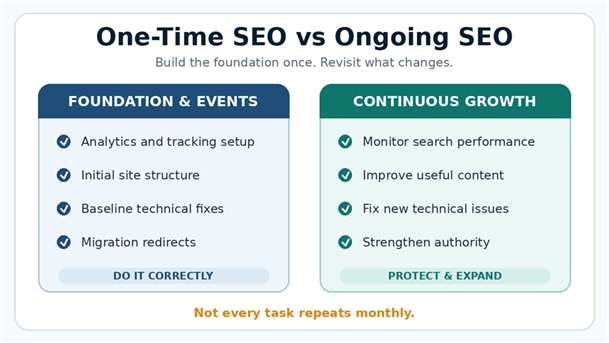
Yes—parts of SEO can be completed once. An analytics account can be connected, a clean URL structure can be designed, and migration redirects can be mapped for a specific launch. A one-time audit can also be useful when an in-house team is ready to implement every recommendation.
But a completed setup is not the same as a completed growth strategy. Even a well-built website can acquire broken links, lose alignment with search intent, publish competing pages, or miss new opportunities. The honest distinction is not “one-time SEO versus endless SEO.” It is foundation work, recurring work, and event-driven work.
What can be one-time or project-based?
- Connecting Google Search Console and analytics, then validating that the data is trustworthy
- Designing an initial site architecture, URL convention, and core template system
- Fixing a defined set of baseline crawl, indexation, redirect, or duplicate-content issues
- Mapping redirects and quality checks for a migration, redesign, or domain change
- Implementing core structured data and reusable metadata templates
What needs continued attention?
Anything whose inputs can change: user questions, competitor pages, internal links, business offers, technical health, content accuracy, search-result presentation, and conversion performance. Continued attention does not mean editing every page every month. It means checking the right signals and acting when evidence justifies the work.
| SEO area | Foundation or one-time action | Ongoing or triggered action |
| Measurement | Connect Search Console and analytics; define conversions. | Validate tracking after changes; review queries, pages, leads, and revenue. |
| Technical SEO | Resolve the initial crawl, indexation, canonical, redirect, and template issues. | Monitor for new errors after publishing, releases, plugins, migrations, or server changes. |
| Content | Map priority topics and publish the strongest first version. | Improve pages when intent, facts, offers, or performance data show a real gap. |
| Internal links | Create a logical hierarchy and connect core pages. | Link new pages, repair orphans, and strengthen important paths as the site grows. |
| Authority | Establish clear authorship, policies, and proof of expertise. | Earn relevant mentions and links through useful assets, relationships, and original work. |
| Strategy | Set goals, audience, positioning, and initial priorities. | Reprioritize based on business value, competitive movement, and measured outcomes. |
The principle: do not manufacture monthly activity. Repeat only the work whose inputs or evidence have changed.
Why SEO Is Not a One-Time Thing
1. Search intent and language can shift
A query may keep the same words while the best answer changes. A market that once wanted a definition may later want a comparison, checklist, tool, or pricing explanation. Search Console query data, customer conversations, and the current results page can reveal that shift. If your page answers yesterday’s version of the question, technically correct content may still become less useful.
2. Competitors keep improving
Your ranking is relative. Another site can publish clearer examples, earn stronger references, improve its page experience, or answer an objection you missed. You do not need to copy every competitor update, but you do need to understand why a different result may better satisfy the searcher. The useful response is a better answer—not a longer article for its own sake.
3. Websites create new technical risk
SEO issues often arrive through normal business activity. A redesign changes canonical tags. A CMS update alters rendering. A deleted product creates internal 404 links. Filters generate crawlable URLs. A new template removes structured data. The initial audit could have been perfect and the site can still develop problems six months later.
4. Content can lose usefulness or accuracy
Prices, screenshots, regulations, product features, statistics, and recommendations can age. Other pages become thin because the company has learned more since publication. Updating should be based on usefulness: correct the facts, add missing decisions or examples, remove obsolete advice, and improve the path to the next action.
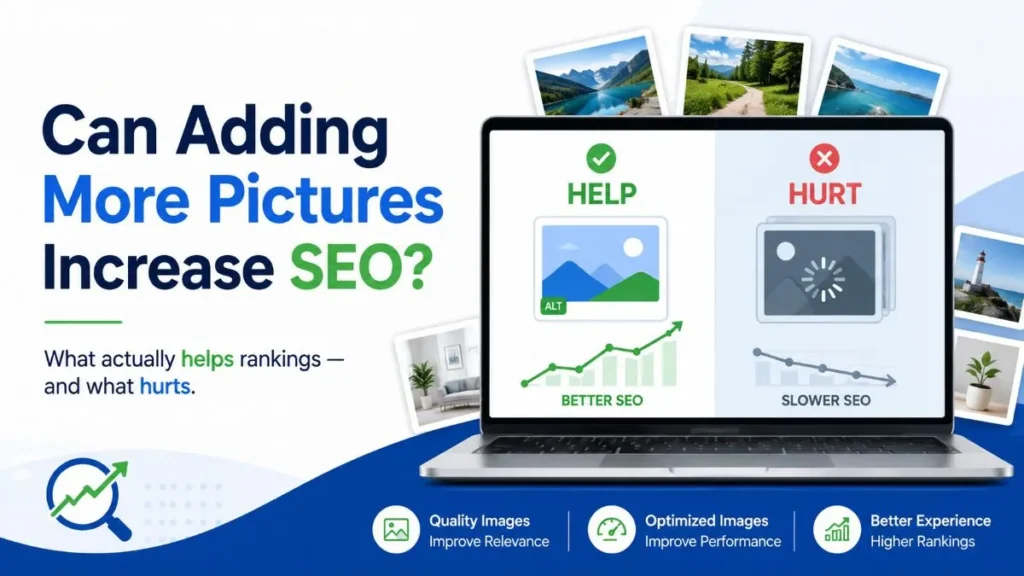
Visuals are valuable when they reduce effort or explain a relationship—not when they are decorative filler. Our related guide, Can Adding More Pictures Increase SEO?, explains how image usefulness, placement, compression, and accessibility matter more than image count.
| FRESHNESS MYTH Freshness is not a universal ranking bonus. Google explains that freshness systems apply when newer information is expected, and its people-first content guidance warns against changing dates or adding and removing text merely to make a page appear fresh. Update because the answer can become better—not because the calendar changed. |
5. Your business and audience evolve
A page optimized for an old service mix, location, price point, or ideal customer can attract traffic that no longer converts. SEO has to stay connected to the business: which work is profitable, which customers are a good fit, which regions matter, and which questions block a purchase. Rankings without alignment create reporting noise rather than growth.
6. Search results and discovery formats evolve
Search results may include videos, forums, product panels, local results, featured answers, or AI-generated experiences. That can change click behaviour and the format users expect. Google’s AI search guidance says established SEO best practices remain relevant to AI features. The goal is not a separate bag of “AI SEO” tricks; it is accessible, indexable, clear, well-supported content that people can trust and act on.
7. Performance data creates the next decision
Before a page is live, keyword research is a forecast. After it is indexed, impressions, queries, click-through rate, engagement, and conversions become evidence. A page ranking from positions 4–15 may need a stronger answer or internal links. A page with many impressions and few clicks may need a more accurate title. A page with traffic but no qualified action may have an offer or intent problem. SEO becomes smarter after launch because real users expose the next opportunity.
What Happens If You Stop SEO?
Usually, nothing dramatic happens the next morning. There is no standard “SEO subscription expired” penalty, and a strong evergreen page can remain visible for a long time. However, the risk compounds quietly: new issues go unseen, the content drifts from the business or searcher, and competitors keep learning.
The pattern below is a risk model, not a promise or fixed timeline. Results vary with competition, site stability, topic volatility, brand demand, link strength, and the quality of the page.
| Period after pausing | What may happen | What to do if you are paused |
| Immediately | Rankings may hold. Existing pages and links do not disappear because active work stops. | Keep Search Console, analytics, uptime, and security alerts active. |
| 1–3 months | Small losses, tracking failures, new crawl issues, or competitor gains may go unnoticed. | Review anomalies, indexation, conversions, and important page changes. |
| 3–12 months | Content and market fit may drift; unresolved technical debt and missed opportunities can compound. | Prioritize the pages and problems with the clearest business impact. |
| Longer term | Recovery can require more work if authority, coverage, or site quality falls well behind the market. | Re-audit assumptions, not just keywords; rebuild from current evidence. |
When a pause may be reasonable
A pause can be sensible when the site is technically stable, the subject is genuinely evergreen, the market is not aggressive, and no major product, CMS, template, or migration work is planned. Even then, use a minimum maintenance layer: preserve measurement, investigate meaningful drops, keep key facts accurate, and test the site after significant changes.
When stopping is higher risk
- The site is new or has little authority and has not yet built topical coverage or trust
- Organic search is a major source of qualified leads or revenue
- The industry, products, prices, rules, or user questions change quickly
- A redesign, migration, CMS change, international rollout, or large publishing programme is underway
- Competitors publish and promote strong resources consistently
- Rankings, clicks, leads, or indexed pages are already declining
What Ongoing SEO Work Actually Matters?
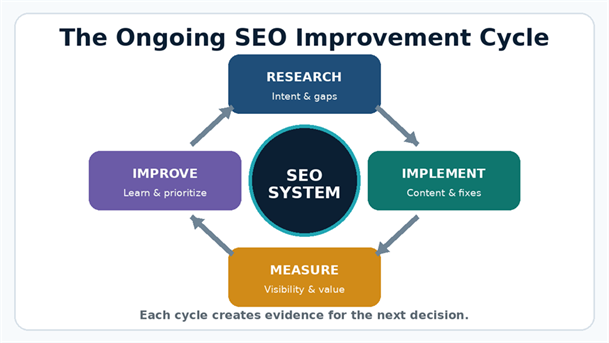
Useful ongoing SEO is not a list of repeated chores. It is a prioritized system that protects discoverability, improves the answer, builds credibility, and measures business outcomes.
Technical health and indexation
- Monitor important pages for crawl, indexation, canonical, redirect, rendering, and structured-data problems
- Test templates and internal links after releases, redesigns, plugin changes, or bulk publishing
- Protect performance, mobile usability, security, and server reliability where they affect real users
- Resolve causes instead of repeatedly clearing symptoms from reports
Content performance and search intent
- Improve pages with clear opportunity: growing impressions, weak click-through, positions near page one, or poor conversion
- Add missing decisions, demonstrations, first-hand examples, definitions, objections, or evidence
- Merge overlapping pages that compete for the same need; remove or redirect content only after checking its value and links
- Keep time-sensitive facts correct, but leave strong evergreen content alone when it still satisfies users
Internal linking and site architecture
Every new page changes the site’s information network. Link from relevant, established pages to important new resources; connect supporting articles to the correct service or category; repair orphan pages; and keep navigation aligned with how users explore. Clear architecture helps both people and crawlers understand relationships.
Authority and trust
Show who created the content, why they are qualified, how claims were checked, and where the reader can verify important facts. Publish original examples, tools, templates, data, or analysis worth citing. Earn relevant links and mentions rather than buying opaque packages. Google says E-E-A-T is not a single ranking factor; treat experience, expertise, authoritativeness, and trust as quality lenses that improve the page for users, not as a score you can mechanically optimize.
Conversion and business measurement
Traffic is an intermediate metric. The real question is whether organic visitors become qualified enquiries, customers, subscribers, or assisted conversions. Connect landing-page performance to meaningful actions, label branded and non-branded demand separately, and investigate pages that attract the wrong audience.
How Often Should SEO Be Reviewed?
There is no universal monthly rule. The right cadence depends on site size, release frequency, competitive pressure, revenue risk, and how quickly the subject changes. Use scheduled reviews for signals and event-driven reviews when the website or business changes.
| FOR A NEW OR LOW-AUTHORITY WEBSITE Monthly planning is often useful because there is more foundational work to execute and learn from—not because every page needs a monthly rewrite. Build a small number of genuinely useful topic clusters, strengthen internal links, earn credible mentions, and measure which queries begin to respond. | ||
| Continuous alerts | Security, downtime, severe tracking failure, manual actions, and critical indexation anomalies. | A high-impact problem threatens discoverability, trust, or revenue. |
| Weekly or biweekly | Large traffic anomalies, important releases, new-page indexation, and priority lead trends. | The movement is material and not explained by seasonality, campaigns, or tracking. |
| Monthly | Search Console query/page trends, conversions, technical crawl samples, work completed, and next priorities. | Evidence points to a specific page, issue, or opportunity. |
| Quarterly | Intent shifts, content portfolio, internal links, topical gaps, competitor changes, and business alignment. | A page or topic deserves a substantive improvement, consolidation, or new asset. |
| Event-driven | Migration, redesign, domain/CMS/template change, new market, major product change, or site incident. | Plan checks before launch, at release, and after search engines process the change. |
How Long Does Ongoing SEO Take to Work?
No honest timeline can guarantee a ranking date. Google’s SEO Starter Guide says some changes may be reflected in hours while others can take several months, and it generally recommends waiting a few weeks before judging whether work had a beneficial effect. Crawling, indexing, competition, site history, content quality, implementation speed, and demand all influence the outcome.
| Evidence stage | What you may observe | How to interpret it |
| Early technical evidence | Important pages become crawlable/indexable; errors or duplicate signals reduce. | The foundation is healthier, but this alone does not guarantee more qualified traffic. |
| Early search evidence | New impressions, additional relevant queries, improved click-through, or movement on target pages. | Search engines and users are responding; validate that the queries match the business. |
| Commercial evidence | More qualified organic sessions, enquiries, assisted conversions, or revenue. | The work is creating business value; continue what is repeatable and investigate weak paths. |
Be especially cautious with exact promises. Google’s guide to hiring an SEO treats guaranteed first-place rankings as a warning sign. A strong provider can explain the plan, evidence, risks, and expected learning milestones—not control the result.
Do You Need a One-Time Audit, Maintenance, or Growth SEO?
| Approach | Best fit | What it should include | Main risk |
| One-time audit | A defined decision or problem, with a capable team ready to implement. | Diagnosis, priorities, evidence, implementation guidance, and a validation plan. | A report creates no value if recommendations remain unimplemented. |
| Maintenance | A stable, established site with limited publishing and modest competitive change. | Monitoring, event checks, critical fixes, selective updates, and business reporting. | Too little attention can allow quiet decay; too much becomes busywork. |
| Growth SEO | A new/low-authority site, competitive category, expansion, or meaningful organic growth goal. | Research, content, technical execution, internal links, authority building, testing, and conversion learning. | Volume without quality can create thin content, debt, and poor-fit traffic. |
Choose the lightest model that can achieve the goal. If the site is stable and organic search is not a growth priority, maintenance may be enough. If the site has no authority, little useful coverage, weak technical foundations, or an ambitious expansion target, an occasional audit will identify work without creating the capacity to execute it.
How to Measure Whether Ongoing SEO Is Worth It
A useful SEO report answers a chain of questions. Can search engines discover the right pages? Are those pages gaining visibility for relevant demand? Are the right people clicking? Do they take valuable actions? What changed, and what will the team do next?
| Decision question | Useful evidence | Primary source |
| Can the right pages be found and indexed? | Indexation status, crawl patterns, canonical choice, sitemap coverage, and critical errors. | Google Search Console plus targeted crawls |
| Are we gaining relevant visibility? | Non-branded impressions, query mix, landing-page clicks, average position trends, and SERP appearance. | Google Search Console |
| Are search snippets earning attention? | Click-through rate by query/page, tested against position, intent, and SERP features. | Google Search Console |
| Are visitors qualified and engaged? | Engaged sessions, key journeys, geography, device, and landing-page behaviour. | Analytics and CRM context |
| Is organic search producing value? | Qualified leads, revenue, assisted conversions, close rate, and cost per useful outcome. | Analytics, CRM, and finance data |
| Are we executing and learning? | Change log, completed priorities, test results, blockers, and next hypotheses. | SEO work log and monthly review |
Google recommends using Search Console and analytics together: Search Console explains performance before the click, while analytics helps show what happens on the site. Neither tool alone proves causation, so annotate major releases, campaigns, outages, and tracking changes before crediting or blaming SEO.
What Should Legitimate Ongoing SEO Include?
Whether the work is internal or outsourced, each review cycle should leave a visible trail from evidence to action. A credible ongoing SEO service should include:
- A prioritized backlog tied to user needs, business value, effort, and risk
- A change log showing what was implemented, when, where, and why
- Technical, content, internal-link, and authority work—not reporting alone
- Performance segmented by page, query, intent, geography, brand/non-brand, and conversion where useful
- Tests or hypotheses with a defined success signal and enough time for evaluation
- Clear blockers, ownership, next priorities, and recommendations to stop low-value activity
Red flags that signal monthly busywork
- Guaranteed number-one rankings or a fixed date with no caveats
- Large activity counts with no explanation of user or business impact
- The same generic audit and report every month while critical fixes remain open
- Mass-produced, unreviewed pages created only to cover keyword variations
- Changing dates or word counts to imitate freshness without improving the answer
- Vague backlink packages with no relevance, editorial standards, or risk explanation
- No conversion tracking, no change log, and no willingness to explain a decline
| A FAIR ACCOUNTABILITY QUESTION Ask: “What changed because of this month’s evidence?” A good answer names the page or system, the user problem, the action taken, the success signal, and the next decision. If the answer is only a list of tools run or words published, the process is not yet accountable. |
A Practical 90-Day SEO Improvement Cycle
| Phase | Priority work | Tangible output |
| Days 1–30: Diagnose | Confirm goals and conversions; inspect indexation and templates; map intent; benchmark priority pages; identify quick risks and high-value gaps. | A prioritized backlog, trustworthy baseline, owners, and success signals. |
| Days 31–60: Improve | Implement the highest-impact technical fixes; upgrade or create the clearest user answers; strengthen internal links; improve snippets and conversion paths. | Documented releases with page-level reasons and expected outcomes. |
| Days 61–90: Validate and scale | Check processing and performance; separate signal from noise; fix regressions; keep what worked; stop weak tactics; plan the next focused cycle. | A learning report, updated priorities, and a smaller set of proven actions to scale. |
A small team does not need dozens of simultaneous initiatives. A minimum viable cycle can be one meaningful technical improvement, one substantial content improvement, one authority or distribution action, and one measurement review—selected because each supports a real goal.
The Bottom Line
SEO is not a one-time thing because search performance depends on changing systems: users, competitors, websites, search results, and business priorities. Yet that does not make every SEO task monthly. Build the foundation, keep measurement alive, monitor the risks that matter, and improve only when evidence shows a better answer or path.
The best ongoing SEO programme should make your website more useful and your decisions more informed over time. If it only creates recurring invoices and recurring reports, it is not the system described in this guide.
| NEED A CLEAR STARTING POINT? If you are unsure which SEO work your site needs now—and what can safely wait—request an initial review from SEO Findings. The useful outcome is a prioritized plan, not a promise of an overnight ranking. |
Frequently Asked Questions
Is SEO a one-time investment?
Partly. A one-time investment can create the technical and strategic foundation, diagnose a problem, or support a specific event such as a migration. Sustainable growth normally needs monitoring and selective improvement because the website, search demand, competitors, and performance evidence change. The right question is which tasks must repeat—not whether every task repeats.
Is monthly SEO always necessary?
No. A small, stable, low-change website may need light monitoring and quarterly reviews, plus checks after important events. A new, complex, fast-changing, or highly competitive website may benefit from monthly or more frequent work. Cadence should follow risk and opportunity, not a package label.
What happens if I stop SEO after reaching number one?
You do not receive an automatic penalty, and the ranking may hold. But number one is not owned: competitors can improve, intent can shift, your page can age, or site changes can create technical problems. Keep measurement and critical maintenance active, then respond when evidence shows a material risk or opportunity.
How often should old content be updated for SEO?
Update when the content becomes inaccurate, incomplete, misaligned with intent, weak against a better result, or demonstrably underperforms. Do not rewrite a strong evergreen page just because a month or year passed. Substantive improvements should help the user make a better decision; changing the date alone is not a useful refresh.
Can a small business do SEO quarterly?
Yes, if the site and market are stable and someone still monitors critical alerts, leads, and major changes. Use each quarterly review to choose a small number of high-impact actions. If the business is launching services, entering locations, publishing frequently, or depending heavily on organic leads, a monthly planning cycle is usually safer.
Will pausing SEO for three months ruin my rankings?
Not necessarily. Some sites hold steady; others lose ground because a competitor moves, a technical issue appears, or demand changes. Preserve Search Console and analytics, avoid risky site changes without SEO checks, and review important pages when the pause ends. The risk is lost visibility and learning—not a timer that triggers punishment.
Should I invest in SEO or PPC?
The best mix depends on urgency, economics, and demand. PPC can create immediate controlled visibility while the budget runs; SEO can build durable discovery and learning but takes time and is not guaranteed. Many businesses use PPC for near-term testing and high-intent coverage while building organic assets that answer recurring customer questions.
How do I know an SEO provider is doing real work?
Ask for the prioritized backlog, change log, implemented URLs, reason for each action, success signal, conversion reporting, blockers, and next decisions. You should be able to connect evidence to work and work to a user or business outcome. Guaranteed rankings, vague backlinks, and report-only retainers are warning signs.
Sources and Further Reading
- Google SEO Starter Guide — How Google describes timelines, measurement, and foundational SEO.
- Creating helpful, reliable, people-first content — Questions for evaluating originality, completeness, trust, and freshness practices.
- Google Search ranking systems guide — How freshness and other systems apply in context.
- Google core update guidance — How to assess meaningful changes without reacting to every small movement.
- Search Console and Google Analytics — How the two data sources complement each other.
- AI features and your website — Why established SEO best practices remain relevant in AI search experiences.
- Do you need an SEO? — Google guidance on hiring, expectations, and ranking guarantees.
- How Google Search works — A plain-language explanation of crawling, indexing, serving, and the absence of ranking guarantees.