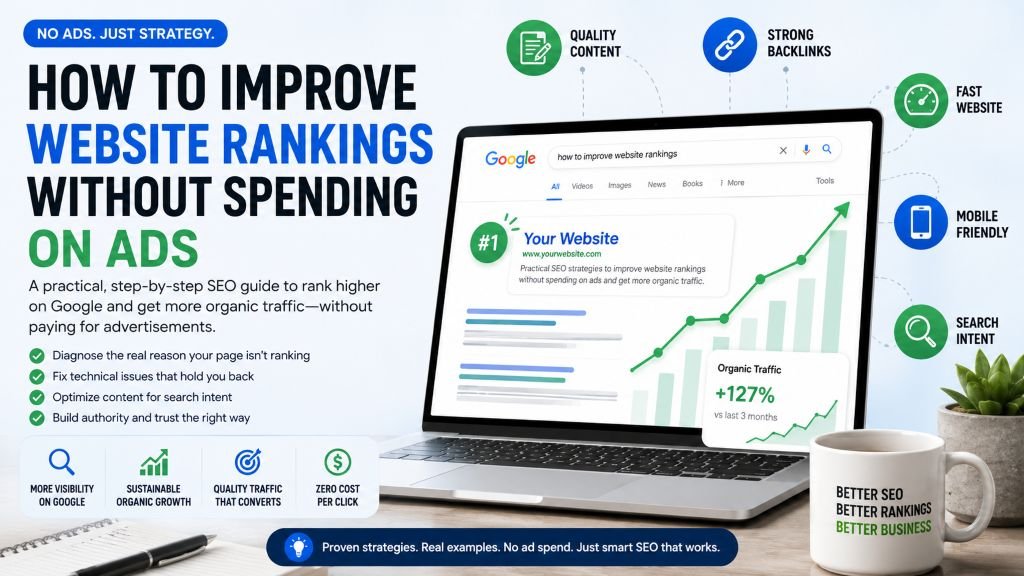
You can improve website rankings without buying ads. Google’s advertising programs do not buy higher organic positions; organic visibility depends on whether Google can access and understand the page, whether the page is relevant to the query, and whether it is useful and trustworthy enough to compete.
That changes the way you should approach a low-ranking page. If a page is blocked by noindex, more backlinks will not solve the immediate problem. If a page already ranks on page two, publishing a second article for the same intent may create more work instead of more visibility. And if qualified visitors already arrive but do not enquire or buy, the bottleneck may be conversion rather than ranking.
| Use this guide like a troubleshooting map Start with the diagnosis and follow the sections that match your situation. The goal is not to complete every SEO task on the internet. It is to remove the highest-impact bottleneck with the least wasted work. |
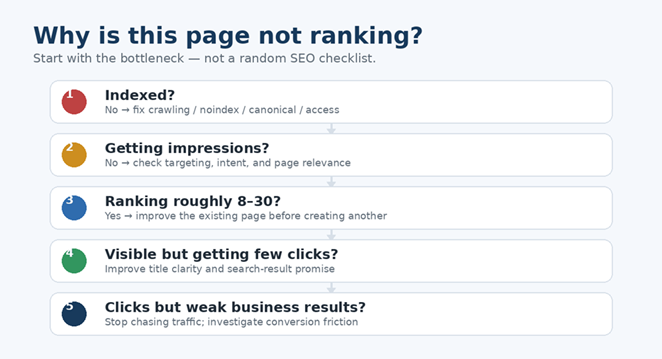
First: diagnose why the page is not ranking
Before changing copy, installing another plugin, or publishing another blog post, identify the symptom. Search Console page-and-query data is much more useful than a vague feeling that “SEO is not working.”
| What you see | Likely bottleneck | What to do first |
| The page is not indexed | Crawling, indexing, canonical, access, or quality issue | Fix discoverability/indexability before rewriting everything. |
| Indexed but gets almost no impressions | Targeting, intent, or relevance problem | Recheck the query and whether this is the right page to satisfy it. |
| Gets impressions and ranks roughly 8–30 | The page has relevance but is not competitive enough | Improve the existing page, internal support, evidence, and authority before creating a duplicate. |
| Visible but gets very few clicks | The search-result promise may be weak or mismatched | Improve title clarity and make the on-page answer deliver the same promise. |
| Qualified traffic arrives but results are weak | Conversion friction or offer mismatch | Fix the post-click experience instead of chasing more traffic. |
1. Make sure Google can find, crawl, and index the page
If the page cannot be indexed properly, content polishing is secondary. Start with Google Search Console’s URL Inspection tool. Check the indexed version, test the live URL, and look for a concrete blocker instead of assuming Google simply has not noticed the page.
Check these first
- An accidental noindex directive on a page that should appear in search.
- A robots.txt rule that prevents Google from crawling a URL or important resources. Remember that robots.txt is a crawl control; it is not a reliable substitute for noindex when the goal is to keep a crawlable page out of the index.
- A canonical tag that points Google toward another URL when this page should be the preferred version.
- Broken redirects, server errors, soft-404-like pages, or a URL that returns little useful content.
- An important page that is isolated from the rest of the site and has no useful crawlable internal links pointing to it.
- Duplicate or near-duplicate URLs where Google has selected a different canonical version.
What a sitemap can and cannot do
A sitemap can help Google discover URLs and can make monitoring cleaner, especially on a new or recently changed site. It does not make an irrelevant or weak page rank. Once the URL is accessible and indexable, the next question is whether the page deserves to be the result for the query.
2. Target a search you can actually satisfy
A keyword is not a good target simply because a tool shows search volume or low difficulty. The page has to match what the searcher expects, and your site needs a credible reason to compete in that result set.
Read the SERP before deciding what the page should be
Search the target query manually and look for the dominant pattern. Are the strongest results how-to guides, service pages, product pages, tools, forums, videos, local results, or a mix? That pattern tells you more about likely intent than forcing a keyword into whichever page you already wanted to publish.
- If Google mostly shows guides, a thin service page may struggle to satisfy an informational query.
- If the results are commercial comparison pages, a purely educational article may answer the topic but miss the decision the searcher is trying to make.
- If a local pack and city-specific businesses dominate, a generic global article may not be the best asset.
- If the query is narrow, do not turn the page into an SEO encyclopedia simply to make it longer.
Check whether you already have a page for the same intent
Before publishing anything new, map the target query to the best existing page. If another URL already satisfies essentially the same searcher goal, improve or consolidate that page instead of creating a second near-duplicate. Separate pages make sense when the intent is genuinely different, not when the wording of the keyword is merely different.
| Simple decision rule Same search intent → improve or consolidate the best existing page. Different search intent → consider a separate page only when the user needs a meaningfully different answer. |
3. Improve the page that already has a chance
One of the best no-budget SEO opportunities is often a page Google already understands. If it has stable impressions or sits close enough to compete, improving that asset can be a better use of time than starting another article from zero.
If the page ranks roughly around positions 8–30
Treat this range as a practical investigation zone, not a Google rule or a guarantee. The page is already relevant enough to appear, so compare it with the pages above it and look for reasons a searcher would prefer them.
- Do they answer the main question faster?
- Do they provide a clearer process, example, screenshot, comparison, or decision rule?
- Do they address an objection or edge case your page ignores?
- Is your content vague, repetitive, outdated, or padded with sections that do not help the task?
- Do competing pages demonstrate real experience or evidence that your page lacks?
- Does another page on your own site explain the same intent better, splitting internal relevance?
If impressions are strong but clicks are weak
Do not automatically add more keywords. Compare the query with the result title and the first visible promise on the page. The title should be specific, descriptive, and accurate; the introduction should then deliver that promise quickly. A meta description can help describe the page, although Google may generate the snippet from the page content when that better matches a particular query.
4. Make the page more useful than the pages already ranking
“High-quality content” only becomes useful advice when it changes what you put on the page. A better article is not automatically the longest article. Google’s people-first guidance explicitly says there is no preferred word count. Write enough to solve the task completely, then remove anything that makes the answer slower or less clear.
Answer first, explain second
If the query has a direct answer, place it near the top. Then explain the conditions, exceptions, examples, and next steps. Long introductions that delay the answer increase effort for the reader without increasing usefulness.
Fill information gaps, not word-count gaps
Do not beat competitors by paraphrasing all of them into one larger page. Add information that changes the reader’s decision or makes execution easier.
- A diagnostic decision tree that tells the reader where to start.
- Examples showing how the same symptom can have different causes.
- A priority order that prevents low-impact busywork.
- Original screenshots, mini case examples, or before/after observations when genuine evidence exists.
- Clear limits explaining what a tactic can help with and what it cannot fix.
- Practical checks the reader can perform immediately without buying another tool.
Remove sections that do not earn their place
Definitions, SEO history, generic motivation, repetitive summaries, and unrelated marketing channels can make a page look comprehensive while making the answer harder to use. If a section does not help the reader diagnose, decide, execute, or measure, question whether it belongs.
Use visuals when they reduce explanation effort
A visual should clarify a process, comparison, example, or piece of evidence. Decorative images can add page weight without adding understanding. Keep important visuals near the text they explain, compress them, and use descriptive alt text that explains the image in context.
5. Optimize titles, headings, and page copy without keyword stuffing
On-page SEO should make the page easier to understand, not make the copy sound as if it was written for a keyword counter. Use the words real searchers use in prominent, natural locations, then write the rest of the page around the topic and task.
Title and H1
- Give the page a unique, concise title that accurately describes what the reader will get.
- Use one clear H1 for the main page topic.
- Keep the title and H1 closely aligned so the result and the page feel consistent, but they do not need to be mechanically identical on every page.
H2s and H3s
Structure headings around the decisions and subproblems the reader actually has. A heading like “Why is the page indexed but getting no impressions?” is more useful than creating multiple headings solely to repeat keyword variations.
Meta description
Write a concise, page-specific summary that helps the searcher understand the value of the result. Treat it as search-result copy, not a direct ranking lever and not a place to list every keyword variation.
Natural semantic coverage
Use relevant concepts naturally where they help the explanation: organic rankings, indexing, search intent, internal links, backlinks, Search Console, page experience, Core Web Vitals, and conversions. Avoid outdated “LSI keyword” checklists, arbitrary keyword-density targets, or forcing exact-match phrases into alt text and anchors.
6. Strengthen internal links and site structure
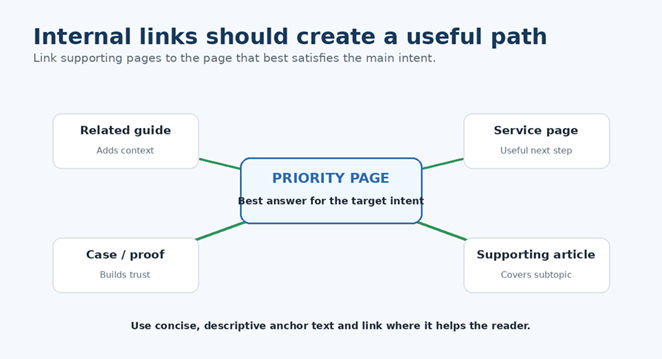
Internal links are one of the highest-control improvements available to a site with no ad budget. They help users discover related information and help search engines understand how pages connect. Important pages should be reachable through crawlable links from relevant pages.
- Link from genuinely relevant pages to the page you want the reader to find next.
- Use descriptive anchor text that makes sense in context; do not repeat an exact-match anchor everywhere.
- When you publish a new article, revisit older relevant pages and add contextual links where the relationship is useful.
- Fix orphan pages that have no meaningful path from the rest of the site.
- If two URLs compete for the same intent, solve the page strategy first; internal links alone do not fix a duplicated intent.
7. Fix technical and page-experience problems that create real friction
Technical SEO matters most when a technical issue prevents discovery, understanding, or a good experience. Do not chase a perfect score while ignoring a page that answers the query poorly.
- Make the page usable on mobile and avoid layouts that require awkward zooming, scrolling, or repeated dismissals.
- Compress oversized media and remove obvious script or plugin bloat that delays the main content.
- Keep HTTPS working correctly and fix mixed-content or security problems.
- Fix broken links and unnecessary redirect chains that interrupt navigation.
- Keep the main content easy to identify; do not bury it behind intrusive interstitials or aggressive pop-ups.
- Use structured data only when it accurately represents visible content and matches a supported feature.
Core Web Vitals: useful signals, not a substitute for relevance
| Metric | What it reflects | Practical meaning |
| LCP | Loading performance | Aim for the main content to appear quickly; Google’s current guidance uses 2.5 seconds or less as a good threshold. |
| INP | Responsiveness | Aim for interactions to respond promptly; Google’s good threshold is under 200 ms. |
| CLS | Visual stability | Avoid layout jumps; Google’s good threshold is below 0.1. |
Use these metrics to find real user-experience problems, but do not treat a passing score as proof that the page should rank. Relevance, usefulness, trust, competition, and other signals still matter.
8. Build authority without buying links
A no-ad strategy should not turn into buying cheap backlinks instead. Google’s spam policies classify links created primarily to manipulate rankings as link spam. A safer long-term approach is to create something other websites have a genuine reason to reference, then make the right people aware of it.
- Publish original data, useful templates, calculators, checklists, diagrams, or case studies.
- Contribute genuine expert insight to relevant publications when you have something useful to add.
- Reclaim legitimate unlinked brand mentions when a contextual link would help readers.
- Build relationships with businesses, communities, associations, and publishers that are relevant to the topic.
- Use selective directories only when they are genuinely useful to customers or the industry.
- Avoid bulk guest-post packages, automated link building, paid-link networks, irrelevant directories, and reciprocal-link schemes created mainly for ranking.
| A useful link test If the link would make sense for real readers even if search engines did not count it, it is much closer to the kind of relationship you want to build. |
9. Use local SEO only when location actually changes the searcher’s choice
Local SEO is powerful for businesses that serve customers in specific areas, but it is irrelevant busywork for many purely online sites. Use it when the query, customer, and service genuinely depend on location.
- Keep Google Business Profile information accurate and complete.
- Use categories and services that truthfully describe the business.
- Earn genuine customer reviews; do not buy or manufacture feedback.
- Create location or service-area pages only where the page provides distinct, location-specific value.
- Avoid mass-produced city pages that differ only by the place name.
- Keep important business details consistent across the places customers actually rely on.
10. Improve search-result clickability without treating CTR as a ranking hack
A clearer search result can win more qualified clicks, but avoid the shortcut claim that artificially increasing click-through rate automatically raises organic rankings. Focus on making the result accurately attractive to the right searcher.
- Align the title with the exact problem the page solves.
- Be specific rather than sensational. A strong promise is useful only if the page delivers it.
- Make the first screen of the article confirm that the visitor reached the right page.
- Build brand trust over time through consistent, useful work rather than trying to manufacture engagement signals.
- Use eligible structured data only where it accurately describes the visible page; structured data can affect search appearance but does not guarantee a rich result or higher organic position.
11. Measure whether the SEO change actually worked
Do not judge SEO by a single manual ranking check. Search results vary by query, location, device, and other context. Measure the page and queries that mattered before the change, then compare the same evidence afterward.
Record a baseline before editing
- The target page and the queries that already trigger it.
- Impressions and clicks in Search Console.
- Average position as context, not the only success metric.
- Indexing status and any known technical issue.
- Organic conversions, qualified enquiries, or other business outcomes when tracking is available.
- The date and nature of the change, so later comparisons are not guesswork.
Interpret the result instead of celebrating one metric
| What changed | What to investigate next |
| Impressions rise, clicks stay flat | The page may be reaching more searches but the result/query fit or title promise still needs work. |
| Clicks rise, business results stay flat | Investigate traffic quality, offer clarity, CTA, trust, form friction, and mobile experience. |
| Position improves but impressions fall | Check whether query mix or seasonality changed before assuming the page is performing better. |
| Nothing meaningful changes | Reassess whether you diagnosed the correct bottleneck instead of repeating the same tactic harder. |
What not to waste time or money on
A no-ad strategy becomes much more effective when you stop treating every SEO tactic as mandatory. These are common distractions when the underlying problem is somewhere else:
- Publishing a new article for every keyword variation when one strong page already covers the intent.
- Adding filler to hit an arbitrary word count.
- Repeating keywords unnaturally in headings, paragraphs, alt text, or internal anchors.
- Changing the date to make old content look fresh without materially improving it.
- Buying low-quality backlinks because ads feel too expensive.
- Chasing a perfect PageSpeed score while the page still fails to solve the query.
- Assuming social shares, email traffic, dwell time, or other engagement metrics automatically become higher organic rankings.
- Using meta keywords or “LSI keyword” lists as if they were modern SEO requirements.
- Mass-producing thin location pages that differ only by city names.
- Publishing generic AI content at scale without expert review, originality, verification, or added value.
- Adding structured data simply because a plugin offers it, even when it does not match the page.
- Tracking only total traffic instead of the pages, queries, and outcomes that actually matter.
A practical 30-day no-ad SEO workflow
Use this as a prioritization cycle, not a promise that a page will reach the top three in 30 days. Some changes may be noticed after a recrawl; others need much longer because competition, authority, site history, and the type of change all affect the outcome.
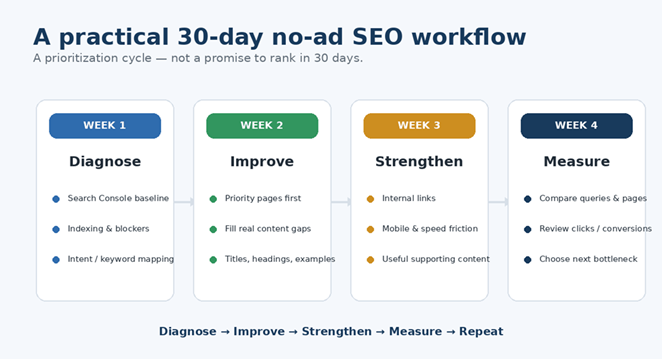
Week 1: diagnose
- Check indexing and technical blockers.
- Export the relevant Search Console page/query baseline.
- Map the target query to the correct existing page.
- Review the live SERP and identify the dominant intent.
- Check whether another URL on your site competes for the same intent.
Week 2: improve the highest-opportunity pages
- Answer the main question sooner.
- Remove filler, stale claims, and sections that do not help the task.
- Add missing decisions, examples, evidence, screenshots, or useful visuals.
- Improve the title and headings so they accurately describe the page.
- Check that the first screen delivers the same promise as the search result.
Week 3: strengthen the site around those pages
- Add useful internal links from relevant pages.
- Fix obvious mobile, speed, broken-link, and navigation friction.
- Create supporting content only when it serves a genuinely different intent.
- Identify a link-worthy asset or expert contribution if external authority is a real gap.
Week 4: measure and choose the next bottleneck
- Compare pages and queries, not just total traffic.
- Review impressions, clicks, and business outcomes together.
- Document what changed and when.
- Choose the next improvement from evidence instead of starting a random new tactic.
So, what should you fix first?
| What you see | First priority |
| Page not indexed | Fix crawl/access/indexing and canonical issues first. |
| Indexed, almost no impressions | Reassess query targeting, intent, relevance, and whether this is the right page. |
| Impressions, weak positions | Improve the existing page, internal support, evidence, and authority. |
| Visibility, few clicks | Improve title clarity and search-result promise. |
| Qualified clicks, weak leads/sales | Investigate conversion friction instead of chasing more traffic. |
| Strong content but clear authority gap | Earn relevant links and references through genuinely useful assets or expertise. |
| Local competitors dominate | Use legitimate local SEO only if location is actually part of the intent. |
| The central idea Do not do more SEO simply because it is free. Do the SEO task that removes the current constraint. Then measure whether the page became easier to discover, more useful to the searcher, and more valuable to the business. |
Frequently asked questions
Can you rank on Google without paying for ads?
Yes. Organic search results are not bought placements. Paying for Google Ads does not purchase a higher organic position. You still need pages that are crawlable, relevant, useful, trustworthy, and competitive for the query.
Do Google Ads improve organic rankings?
No. Ads can buy paid visibility, but Google keeps advertising separate from organic ranking. A business may benefit from running ads for other reasons, but ad spend is not an organic ranking shortcut.
Should I update an old page or publish a new one?
Update or consolidate the existing page when it already serves the same search intent and should remain the primary result. Create a new page when the user’s goal is genuinely different and deserves a separate answer.
What should I do if a page ranks between positions 11 and 30?
Treat it as an opportunity to investigate. Compare intent, usefulness, examples, evidence, internal links, and authority with the pages above it. Do not assume that simply adding words will move it higher.
How long does SEO take to improve rankings?
There is no universal timeline. A technical fix may be noticed after recrawling, while content, authority, and broader site improvements can take much longer. Competition, crawling, site history, and the type of change all affect timing.
Do I need backlinks to improve rankings?
Not every query or page needs the same level of external authority. Fix accessibility, intent, usefulness, and internal linking first. When external authority is genuinely the gap, earn references through useful assets and credible expertise rather than buying manipulative links.
Does a longer article rank better?
Not because it is longer. Google says there is no preferred word count. Write enough to solve the user’s task completely, then remove content that makes the answer slower or less clear.
Do social media and email traffic improve Google rankings?
They can help people discover your content, build an audience, and create indirect opportunities such as branded searches or natural links. They should not be presented as direct switches that automatically raise organic positions.
How often should old content be updated?
Update it when something meaningful has changed: facts, guidance, examples, screenshots, search intent, product details, or the usefulness of the page. Changing the date alone is not a substitute for a real update.
Can a new or low-authority site compete without an ad budget?
Yes, but topic selection and prioritization matter more. Start with queries the site can genuinely satisfy, build strong pages and internal structure, publish evidence or expertise that earns trust, and expand into harder topics as the site proves relevance and authority.
Final takeaway
Improving website rankings without spending on ads is not about finding a hidden free shortcut. It is about diagnosis and prioritization: make sure Google can access the page, target the right intent, improve the page with the best opportunity, connect it properly within the site, earn authority honestly, improve real user friction, and measure what changed.
When each action is tied to a real problem, SEO becomes less about doing more work and more about doing the right work.
| Need a second opinion on what is actually holding a page back? SEO Findings can review the page, separate ranking issues from conversion issues, and prioritize the changes that are most likely to matter before you spend time on another generic SEO checklist. |