A strong architecture portfolio can still be almost invisible in search. A prospective client may love your work once they see it, but first they have to find the right page, understand that you handle their kind of project, trust your experience, and know what to do next.
That is the real job of SEO for architectural firms. It is not to collect the largest possible traffic number. It is to make your services, project experience and locations discoverable when a suitable client is actively researching an architect — then give that person enough useful evidence to move forward.
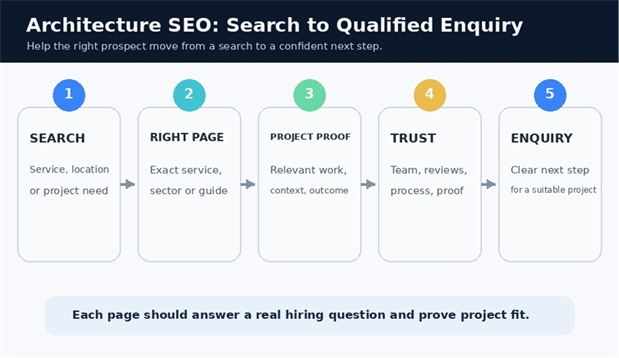
| Quick answer The strongest architecture SEO strategy connects five things: the projects you want, the searches those clients make, the page that best answers each search, proof from relevant work, and a clear enquiry path. If one of those links is weak, rankings or leads usually stall. |
- Start with business fit, not keyword volume. Choose the services, project types and locations you genuinely want to grow.
- Build the right page for the intent. A service query should not be forced onto a generic homepage or an unrelated blog post.
- Turn projects into evidence. A searchable case study should explain the brief, constraints, solution, scope and outcome — not only display images.
- Treat local visibility and technical health as foundations. Accurate business information, crawlable pages, mobile usability and image performance matter because architecture sites are often visual and location-sensitive.
- Measure qualified enquiries. Traffic and rankings are useful diagnostics; the business outcome is whether the right projects are reaching you.
Why SEO for Architectural Firms Is Different
Architecture is a high-consideration professional service. A client may be comparing style, sector experience, location, process, credentials, project scale and personal fit before they ever contact a firm. That makes the website more than a digital brochure: it is often part search engine, part portfolio, part trust document and part lead filter.
The website is visual, but search still needs context
Large photography, renders and drawings are essential for showing design quality. The problem appears when a project page contains almost no text beyond a project name. A human can infer a lot from a photo; a search engine and a first-time visitor may not know the project type, location, problem solved, services delivered or why the work is relevant to their own brief.
The goal is project fit, not maximum traffic
A broad article can bring thousands of visitors and still produce no suitable enquiries. A smaller service or project page that ranks for a specific need can be far more valuable. For an architecture firm, useful SEO asks: “Would the person behind this search plausibly become a suitable client?”
Local relevance and specialist expertise can both matter
Some firms depend heavily on a defined city or region; others compete for specialist projects across a wider market. Your SEO structure should reflect the way the firm actually wins work instead of copying a generic local-business template.
1. Start With the Projects You Actually Want More Of
Keyword research should not be the first strategic decision. First decide what you want search visibility to produce. If your priority is high-end residential renovation, for example, ranking for a broad informational term about famous architects may be irrelevant.
Define your priority services and project types
List the work that is commercially important and realistically supported by your experience. Depending on the practice, that might include residential architecture, commercial interiors, hospitality, adaptive reuse, conservation, healthcare, workplace design, sustainable design, masterplanning or another specialty.
Define the markets you genuinely serve
Separate real service areas from places you merely want to mention for SEO. A useful location strategy should be backed by genuine availability, project experience, office presence, regional knowledge or another meaningful reason the page helps the user.
Describe an ideal enquiry before choosing keywords
Ask what a good lead would tell you: project type, location, stage, timeline, scope and any special requirements. This simple exercise makes keyword choices much sharper because you can reject terms that attract the wrong intent.
| Decision filter Before creating a page, ask: If this page ranked and brought enquiries, would we actually want those enquiries? If the answer is no, the keyword is probably not a priority. |
2. Find the Search Terms Real Architecture Clients Use
The best keyword set usually mixes services, project types, locations and pre-hire questions. Do not choose a phrase only because a tool reports search volume. A term is useful when its intent matches something the firm can answer better than the current results.
Service and project-type searches
These are often closest to a hiring decision: “residential architect”, “commercial architecture firm”, “historic renovation architect”, “passive house architect” or another specific specialty. The right destination is usually a service or sector page — not a blog article explaining the dictionary definition of the service.
Service + location searches
Examples include “residential architect in Austin”, “architects in Manchester” or “commercial architect near me”. These searches deserve local relevance, but the page still needs strong service and project evidence. Repeating a city name dozens of times is not local expertise.
Problem and planning questions
Prospects also search before they are ready to hire. Useful topics may include whether an architect is needed for a renovation, what happens during schematic design, how long a design phase can take, what information to prepare before a consultation, or how to compare architectural services. The exact questions will vary by market, so use Search Console data, sales conversations and keyword research to validate them.
| Search intent | Example | Best destination |
| Hire a specialist | commercial renovation architect | Service / sector page |
| Hire locally | residential architect in [city] | Strong location or local service page |
| See proof | hotel architecture projects | Project hub / case study |
| Research a decision | do I need an architect for an extension? | Helpful guide |
| Compare approaches | architect vs design-build | Comparison / educational guide |
The principle is simple: map each meaningful search intent to one clearly useful page. Do not make several near-identical pages compete for the same query.
3. Build the Website Around How Prospects Search
A clean site structure helps people understand the practice and helps Google discover how pages relate. Most architecture websites do not need a complicated ecommerce-style hierarchy. They do need a deliberate relationship between services, sectors, locations, projects and educational content.
- Homepage: Explain the firm at a high level and route visitors to the most important services and proof.
- Service pages: Cover distinct services with enough detail to answer a project-ready search.
- Sector or project-type pages: Use them when the firm has a meaningful body of experience in a specific market.
- Location pages: Create only where there is real user value and genuine relevance.
- Project pages: Provide evidence for services, sectors, design approaches and locations.
- Guides / resources: Answer the questions prospects ask before contacting a firm.
- About and team pages: Show who is responsible for the work, relevant experience and the way the practice operates.
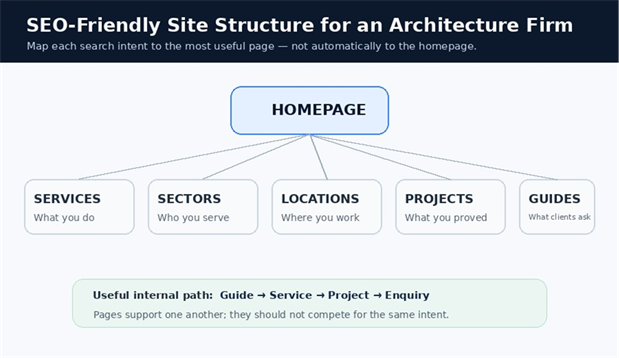
Internal linking should follow the same logic. A guide about planning a commercial renovation can link to the relevant architecture service; that service can link to completed renovation projects; those projects can link back to the service and to related case studies. The path should help the reader continue, not merely distribute keywords.
4. Make Service Pages Useful Enough to Deserve the Search
A service page should not be a thin block of promotional copy wrapped around a contact form. When a prospective client lands on the page, they are trying to decide whether the firm understands their kind of work and whether it is worth starting a conversation.
A strong architecture service page should answer
- What exactly does the firm provide?
- Who is the service appropriate for?
- Which project types and sectors are relevant?
- Where is the service offered?
- What does the process generally involve?
- What constraints or decisions does the firm typically help manage?
- Which completed projects prove the capability?
- Who will be involved and what experience is relevant?
- What is the logical next step for a suitable prospect?
On-page elements still matter — but they should read naturally
Use a descriptive title, one clear H1, useful H2/H3 headings, an early explanation of the service, relevant internal links, strong project examples and a focused CTA. Include the target language where it helps clarity. Do not force “seo-style” repetition into every heading or image description.
5. Turn Portfolio Pages Into Search Assets, Not Image Galleries
This is one of the biggest missed opportunities on architecture websites. A project can be your strongest evidence of experience, yet many portfolio pages hide that value behind a grid of beautiful images and a one-line caption.
A better project page tells a concise project story. It gives the prospect enough context to recognize a similar need and gives search engines enough information to understand the page beyond the images.
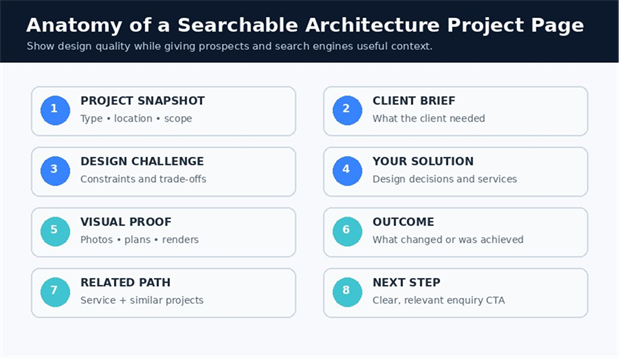
Use this project-page framework
1. Project snapshot — name, project type, location and scope where appropriate.
2. Client brief — what the client needed or what the project had to accomplish.
3. Design challenge — constraints, trade-offs, site conditions, planning issues or other meaningful complexity.
4. Your response — the design approach and the services the firm actually delivered.
5. Visual proof — carefully selected photography, drawings, plans or renders that support the story.
6. Outcome — what was delivered, improved, approved, completed or learned, without inventing results you cannot substantiate.
7. Related path — links to the relevant service, sector and similar projects.
8. Next step — a CTA that makes sense for a prospect considering comparable work.
Avoid the opposite problem: templated project-page filler
Do not turn every portfolio page into 1,000 words of generic copy. The point is not length. The point is specific, decision-useful context. If a project has little to say, keep it concise. If it illustrates a difficult design problem or a specialist service, explain that in enough detail to be useful.
6. Optimize Architecture Images Without Ruining the Portfolio
Architecture sites need strong visuals, so image SEO is a balancing exercise: preserve the quality that sells the work while removing unnecessary page weight and giving each important image useful context.
Resize and compress before upload
Do not upload an enormous source file only to display it at a much smaller size. Prepare images for the maximum size they actually need on the site and use responsive image delivery so browsers can choose an appropriate version for the device.
Use descriptive filenames and accurate alt text
A filename such as “brick-courtyard-house-exterior.jpg” is more useful than “IMG_5847.jpg”. Alt text should describe the image in the context of the page, especially when the image conveys meaningful information. Avoid turning alt attributes into lists of keywords. Google’s image guidance explicitly recommends useful, contextual alt text and warns against keyword stuffing. Google image SEO guidance
Put the image next to the text it supports
If an image demonstrates the main design solution, place it close to the explanation of that solution. This improves comprehension for the user and gives the image stronger contextual meaning.
Protect layout stability and load performance
Reserve image dimensions so the layout does not jump while media loads. Be careful with the largest above-the-fold image because it can influence loading experience. Lazy-load genuinely below-the-fold imagery where appropriate instead of applying the same behavior to every image indiscriminately.
| Architecture-specific rule Do not sacrifice the visual quality that helps clients judge the work merely to chase a perfect speed score. Remove waste first: oversized files, unnecessary scripts, poor responsive delivery and avoidable layout shifts. |
7. Build Local Visibility With Real Evidence
For firms that serve defined geographic markets, local SEO can connect the practice with searches that include a city, region or “near me” intent. The goal is not to manufacture local signals; it is to make genuine local relevance easy to verify.
Complete and maintain the Google Business Profile
Keep core business information accurate, choose categories that genuinely fit the practice, add useful project photography, keep hours and contact details current, and encourage genuine reviews from clients. Google states that local results are mainly based on relevance, distance and prominence, so there is no setting that can force a top local position. Google local ranking guidance
Use location pages only where they help
A location page should do more than swap one city name for another. Useful local evidence can include projects in that market, services actually offered there, local contact information where applicable, region-specific process information and links to relevant work. If you have nothing unique to say, a cloned city page is unlikely to help users.
Google’s spam policies specifically call out doorway abuse, including multiple pages targeted at similar city or regional queries that funnel users to the same destination. They also warn against blocks of city names used as keyword stuffing. Google spam policies
Make claims about local regulations carefully
Planning, licensing, registration and building rules vary by jurisdiction and can change. If you publish guidance about them, use current primary sources, identify the location clearly and state the limits of the information. That is better for users and stronger evidence of editorial care.
8. Create Content Around the Client’s Decision Journey
“Start a blog” is not a strategy. Architecture content earns attention when it reduces uncertainty before a project begins or demonstrates how the practice thinks about real design decisions.
Early research content
Answer broad but relevant questions that appear before a prospect has chosen a firm. Examples might include what an architect does during a renovation, when architectural services are useful, what information to prepare before a first meeting, or what different project phases involve.
Evaluation content
Help the reader compare options and understand trade-offs: architect versus design-build, renovation versus new build, planning considerations, material choices, sustainability decisions, typical process stages or how to review a proposal. Avoid pretending a universal answer exists when the right answer depends on project scope and location.
Selection-stage content
Case studies, process pages, team expertise, project-specific FAQs and clear service descriptions matter here. The user is no longer asking “what is architecture?” They are asking “can this firm handle my project?”
| Content test Before publishing, ask: Does this piece help a prospective client make a better decision, understand a process, evaluate fit, or see credible proof? If not, it may be content for the sake of content. |
9. What About AI Overviews and AI Search?
The current search results for architecture SEO already show AI-generated answers, so it is reasonable to ask whether firms need a separate “AI SEO” system. Google’s current guidance says the foundational SEO practices remain relevant to generative AI features in Search, and emphasizes valuable, non-commodity content rather than a separate set of tricks. Google guidance for AI search
For an architectural practice, that points back to the same durable work: make important pages crawlable, publish clear service and location facts, show original project evidence, explain decisions that only your team can explain, identify the people responsible for the content, and structure pages so a user can quickly understand what the firm actually knows and does.
Do not create dozens of generic “AI-optimized” pages that merely paraphrase other websites. Unique project experience, original visuals, expert explanations and precise local/service information are much harder to replace with commodity text.
10. Fix Technical Problems That Hide or Weaken Good Content
Technical SEO should support discoverability and user experience. It should not become a hunt for a perfect tool score while priority service pages remain thin or confusing.
Make sure important pages can be crawled and indexed
- Confirm priority pages return a normal success response and are not accidentally blocked or set to noindex.
- Maintain a clean XML sitemap and use Search Console to inspect important URLs when troubleshooting.
- Fix broken internal links and unnecessary redirect chains that interrupt discovery or navigation.
- Use canonical signals consistently when several URLs can expose substantially the same content.
- Make important text and links available in the rendered page rather than hiding critical content behind inaccessible interactions.
Keep mobile parity and usability
Google uses the mobile version of a site’s content for indexing and ranking. A portfolio that works beautifully on desktop but hides text, links or key images on mobile creates both user and search problems. Google mobile-first indexing guidance
Pay attention to Core Web Vitals — in context
Architecture websites can be heavy because of high-resolution media, sliders, animation and third-party scripts. Improve loading performance, interactivity and visual stability, but remember that strong Core Web Vitals do not guarantee top rankings by themselves. They are part of a broader page experience. Google Core Web Vitals guidance
Use structured data only when it accurately describes visible content
Do not add invented “project schema” simply because a competitor mentions schema. Use supported structured data that truthfully represents the page — for example Article/BlogPosting for an editorial guide, Breadcrumb for navigation, and appropriate Organization or LocalBusiness information where it genuinely applies. Structured data can help Google understand content, but it does not create a ranking entitlement or guarantee a rich result.
11. Build Authority Without Buying Junk Links
Links can help Google discover pages and understand relevance, but architecture firms have better opportunities than mass directory submissions or paid guest-post packages. The strongest mentions are usually connected to real work, expertise or relationships.
Architecture-specific authority opportunities
- Project features in reputable architecture, design or local publications.
- Professional associations and legitimate directories that clients or peers actually use.
- Project partners such as engineers, contractors, landscape designers or specialists where a natural editorial mention makes sense.
- Supplier or manufacturer case studies when a completed project genuinely demonstrates their product or system.
- Awards, exhibitions, lectures, research, design resources or original data that gives publishers a reason to cite the firm.
- Local press coverage tied to real projects, community work or planning milestones.
Avoid buying links for ranking purposes, automated link creation, low-quality directories and excessive reciprocal-link arrangements. Google’s spam policies explicitly identify these patterns as link spam when they are used primarily to manipulate rankings.
12. Show Experience and Trust Instead of Claiming It
E-E-A-T is most useful as an editorial discipline, not a keyword checklist. The page should make it easy to understand who created the information, what first-hand or professional basis supports it, and why a reader should rely on it.
For an architecture firm, that can include
- Named team members and accurate roles.
- Relevant qualifications, registrations or memberships without exaggeration.
- Original completed projects and clear statements about the firm’s actual role.
- Real client testimonials or reviews where permission and platform rules allow.
- Awards and press mentions that can be verified.
- A transparent process and realistic explanation of what the firm does and does not provide.
- Primary sources for factual claims about regulations, standards or planning requirements.
For SEO content written by a marketing specialist, the same honesty matters: demonstrate SEO experience and methodology, cite reliable search guidance, and do not imply that the author is a practicing architect unless that is true.
13. Convert Organic Traffic Into Qualified Project Enquiries
Ranking is only the first half of the problem. If the page earns the click but the visitor cannot tell whether the firm handles their project, the SEO strategy has created attention without progress.
Match the CTA to the page
A service page can invite a project discussion. A project case study can ask whether the reader is planning something similar. An early-stage guide may be better served by links to the relevant service and project examples before asking for a consultation.
Use forms to reduce friction and improve fit
Keep the enquiry path easy on mobile. Ask only for information the team will genuinely use. Depending on the practice, useful fields might include project type, location, current stage, broad timeline and contact details. Do not turn the first interaction into a twenty-question qualification exam.
Put proof near the decision
If the service page claims specialist experience, show the most relevant projects close to that claim. If a process is a differentiator, explain it before the CTA. If the client is likely to worry about fit, answer that concern before asking them to contact you.
14. Measure SEO by Search Visibility and Enquiry Quality
Organic traffic is useful, but it is not the final score. A practical measurement system connects search performance with the kind of enquiries the firm actually wants.
Search diagnostics
- Impressions for relevant queries
- Clicks and click-through rate where useful
- Average position as a directional metric, not an absolute business outcome
- Which service, project and guide pages are earning visibility
- Indexing or crawl issues affecting important pages
Lead and business outcomes
- Qualified contact-form enquiries
- Calls or consultation requests attributable to organic landing pages
- Project type and location of suitable enquiries
- Which pages assisted the enquiry journey
- Won projects where attribution is reliable enough to record
Be careful with simplistic engagement claims. A user can get the answer they need quickly and leave, or spend a long time confused on a poor page. Use behavior data to diagnose experience, not as a shortcut for deciding whether content “deserves” to rank.
15. A Practical 90-Day SEO Roadmap
SEO has no reliable ninety-day ranking guarantee. A roadmap is still useful because it prevents teams from doing advanced promotion while basic site problems remain unresolved.
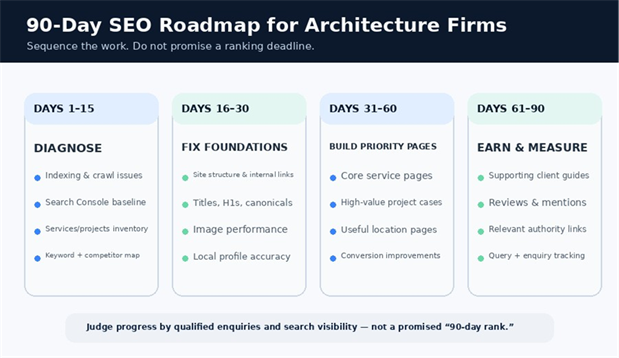
Days 1–15: diagnose
- Check indexability, crawl paths and Search Console data.
- Inventory services, sectors, locations and project pages.
- Identify which business priorities are missing suitable landing pages.
- Map target queries and review the pages currently ranking for them.
- Record a baseline before major changes.
Days 16–30: fix the foundations
- Repair critical technical issues and broken internal paths.
- Improve titles, H1s, introductory copy and page purpose on priority URLs.
- Reduce avoidable image and script weight.
- Correct Google Business Profile and key business information where local SEO matters.
- Remove or consolidate pages that duplicate the same intent without adding value.
Days 31–60: strengthen the pages closest to revenue
- Build or improve the core service pages.
- Turn the strongest relevant projects into useful case studies.
- Create genuinely useful location pages only where warranted.
- Add contextual internal links from supporting content and related projects.
- Improve the enquiry path on pages already earning relevant traffic.
Days 61–90: expand useful coverage and authority
- Publish a small number of high-value client questions instead of filling a calendar.
- Earn legitimate reviews, mentions and project coverage.
- Promote link-worthy project stories or original resources.
- Compare Search Console query/page data with the baseline.
- Prioritize the next bottleneck rather than repeating the same checklist.
Common SEO Mistakes Architecture Firms Should Avoid
1. Using a visually impressive portfolio with almost no project context.
2. Targeting only broad terms such as “architect” while ignoring services, project types and intent.
3. Creating dozens of thin city pages with nearly identical copy.
4. Uploading oversized images and letting the portfolio become unnecessarily slow.
5. Publishing generic AI-written articles that add no project experience, expert perspective or original value.
6. Copying competitor headings and advice instead of solving the prospect’s decision problem better.
7. Stuffing target phrases into titles, headings, alt text and footer blocks until the copy sounds unnatural.
8. Sending every searcher to the homepage instead of creating a useful page for the specific intent.
9. Ignoring internal links between guides, services and project proof.
10. Buying low-quality links or treating any directory listing as automatically valuable.
11. Measuring traffic growth while ignoring whether the enquiries are relevant.
12. Claiming credentials, local experience, outcomes or regulatory advice that cannot be supported.
DIY SEO vs Hiring an SEO Specialist
A small practice can handle many basics internally if someone has the time to learn, update the site and review performance. Google itself notes that small local businesses can often do much of the work themselves. Professional help becomes more useful when technical problems are difficult, several services or markets need restructuring, a redesign or migration is planned, or the team cannot turn data into a clear priority list.
If you hire help, ask for an explanation of the strategy, realistic expectations and the reasoning behind changes. Be wary of anyone who guarantees first place in Google; Google’s own guidance tells site owners to avoid that promise.
If your practice needs hands-on support with service pages, project pages, technical foundations, and qualified enquiries, review my SEO services for architects.
FAQ: SEO for Architectural Firms
What is SEO for architectural firms?
It is the process of making an architecture firm’s website easier to discover and understand when prospective clients search for relevant services, project types, locations or pre-hire questions. It combines useful content, page structure, technical accessibility, local visibility, project proof, internal linking and legitimate authority building.
Does SEO work for architecture firms?
It can work when search demand overlaps with the firm’s services and the website gives the searcher a genuinely useful reason to choose or contact the practice. SEO is less effective when a firm targets irrelevant volume, has no differentiated proof, or expects rankings to compensate for an unclear offer.
What are the best SEO keywords for an architecture firm?
The best keywords are the ones that match profitable, realistic services and genuine client intent. Service + location, specialist project type, sector and decision-stage questions are often more useful than broad, high-volume terms. Validate them with keyword data, the live SERP, Search Console and real client conversations.
Is local SEO important for architects?
Yes for firms whose projects are tied to specific markets. Keep the Business Profile accurate, earn genuine reviews, show local project evidence and create local pages only where they add unique value. Firms competing nationally or internationally may need a different balance between local and specialist search visibility.
Should every architecture project have its own page?
Not automatically. Create an individual page when the project has enough unique value, proof or search relevance to deserve one. Small or repetitive projects can sometimes be grouped in a well-organized portfolio rather than generating dozens of near-duplicate pages.
How do you optimize an architecture portfolio for SEO?
Give important projects descriptive titles, meaningful context, optimized images, accurate alt text, crawlable internal links and connections to the relevant service or sector pages. Explain the brief, challenge, design response and outcome where those details help a prospective client judge fit.
Can large portfolio images hurt SEO?
Oversized media can slow loading and contribute to a poor experience, especially on mobile. Resize and compress images intelligently, use responsive delivery and preserve the quality necessary to evaluate the work. The goal is efficient visual quality, not simply the smallest possible file.
How long does SEO take for an architecture firm?
There is no fixed timeline. Google notes that some changes may be reflected within hours while others can take several months, and it recommends allowing time to assess whether improvements helped. Competition, site condition, existing authority, crawl frequency and the scale of the work all affect the timeline.
Can an architecture firm do SEO in-house?
Yes, particularly the parts closest to the firm’s expertise: project details, client questions, service explanations and review of what makes an enquiry suitable. Technical SEO, migrations, advanced analysis or highly competitive markets may justify specialist support.
What should an architecture firm measure?
Track relevant search visibility, the performance of priority pages, technical/indexing health and — most importantly — qualified enquiries. The best report connects the query and landing page to the kind of project the firm actually wants.
Final Architecture SEO Checklist
✓ Priority services and project types are defined before keyword targeting.
✓ Important searches map to one clearly useful page each.
✓ Core service pages answer project-ready questions and show proof.
✓ Strong portfolio projects include enough context to be searchable and persuasive.
✓ Images are resized, compressed, contextual and given accurate alt text where needed.
✓ Local business information is accurate and location pages provide real local value.
✓ The site is crawlable, indexable, mobile-usable and free of major broken paths.
✓ Internal links connect guides, services, locations and relevant projects logically.
✓ Content answers real client decisions instead of filling a publishing calendar.
✓ Credentials, claims and regulatory information are accurate and supportable.
✓ Authority is earned through legitimate mentions, relationships and useful work — not link schemes.
✓ Success is measured by qualified organic enquiries as well as search visibility.
The Bottom Line
The strongest SEO for architectural firms does not make a beautiful website look more “optimized.” It makes the practice easier to discover, easier to understand and easier to trust for the projects it genuinely wants.
Start with the work you want. Build the page a suitable client needs. Prove that you have handled relevant problems before. Keep the site technically accessible and locally accurate. Then measure whether the right people are finding you — and whether they are turning into the right enquiries. That approach is slower than chasing shortcuts, but it creates something far more defensible: a search presence built around real expertise, real projects and useful answers rather than generic SEO filler.