
Audiology marketing ideas are useful only when they solve a problem your clinic actually has. A practice that cannot be found for nearby hearing tests needs a different first move from one that gets enquiries but struggles to turn them into appointments. The goal is not to be everywhere online. It is to help the right people find your clinic, understand their options and take an appropriate next step.
Start by identifying the constraint: visibility, patient confidence, booking access, referral flow or follow-up. Then choose a small number of actions you can manage and measure. This guide shows what to do, what to avoid and how to tell whether a marketing activity is helping people reach care.
Which Audiology Marketing Idea Should Your Clinic Try First?
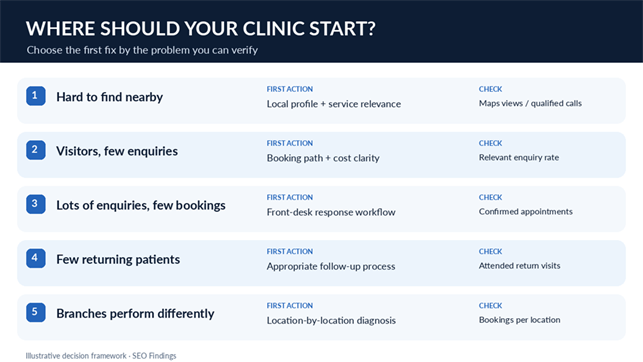
Before buying ads or committing to a content calendar, answer one question: where does the patient journey currently break down? Use your website, Google Business Profile, front-desk records and scheduling process to check the evidence. An attractive idea is not a priority unless it addresses that break.
| What you observe | Investigate first | Measure |
| Patients cannot find the practice nearby | Google Business Profile accuracy, relevant services and legitimate location pages | Qualified local calls and directions, then appointments |
| People visit the website but do not enquire | Page clarity, hours, fees, mobile forms and book-now options | Enquiry rate from relevant service pages |
| Enquiries arrive but appointments are not confirmed | Missed calls, response times, booking handoffs | Enquiries that become confirmed appointments |
| Existing patients stop returning | Clinically appropriate follow-up and communication processes | Scheduled and attended follow-up visits |
| Branches have very different results | Each real branch’s location presence and booking path | Qualified bookings by location |
If you have no reliable baseline, begin with a one-week manual audit: make five relevant searches from appropriate locations, test the booking path on a phone, ask the front desk how new enquiries are recorded, and note questions that prospective patients repeatedly raise. Do not infer clinical demand from keyword volume alone.
12 Audiology Marketing Ideas That Address Real Clinic Problems
These are not twelve campaigns to launch at once. Choose two or three that match the issue you identified, make the minimum useful change and review real patient actions before expanding.
1. Improve Audiology Local SEO and Google Business Profile Accuracy
Use this when patients searching for an audiologist, hearing evaluation or hearing aid fitting near your actual clinic cannot reliably find or identify you. Verify your Google Business Profile, use the most accurate eligible category, keep hours and contact details current, and list services the practice genuinely provides. Add clear photos of the real practice and an accessible way to contact the team.
Then test different search intents: “hearing test near me,” “audiologist in [city]” and a relevant service query. Check both Maps and regular results. Google says local results mainly reflect relevance, distance and prominence; there is no way to pay Google for a better organic local position.
Avoid rented addresses, fictional branches or city pages that pretend a clinic operates where it does not. Judge progress by qualified enquiries and actual appointments, not by screenshots of one search from one location.
If your hearing clinic struggles with local visibility, service-page rankings or technical SEO issues, explore our hearing aid SEO services for audiologists and clinics to understand what a professional review can cover.
2. Build Hearing Test, Hearing Aid Fitting and Other Service Pages Around Patient Questions
A single “Services” page often asks visitors to guess whether their particular concern is covered. If the clinic genuinely offers separate services, give each important service a useful page: who the service is for, how the appointment works, what the patient should bring, whether a referral is needed, available accessibility arrangements and how to book.
For example, a hearing-evaluation page should not be a brand catalogue in disguise. Someone looking for a first hearing test needs practical information about the evaluation, not a wall of device specifications. A hearing aid fitting page can explain adjustment, follow-up and what the clinic includes in its care pathway—subject to clinical review.
Use actual appointment questions as source material and add contextual internal links between appropriate services and location pages. Measure relevant search queries and service-page enquiries, not just pageviews.
3. Make Audiology Appointment Booking Clear on Every Important Page
If a patient can find you but does not book, inspect the journey rather than assuming you need more traffic. On a phone, is the booking action obvious without aggressive pop-ups? Can a patient request an appointment without making a voice call? Are the location, hours, accessibility options and next steps clear?
A useful first-visit message is straightforward: “Book a hearing evaluation. We’ll confirm the appointment details and explain what to expect.” Use only promises the clinic can actually deliver. If an external scheduler opens, test it from the beginning through confirmation; an outbound click is not a booked appointment.
Ask staff to record missed calls, repeated booking questions and abandoned handoffs. A page with fewer visits but more confirmed, appropriate evaluations may be more valuable than one with impressive traffic totals.
4. Answer Hearing Aid Costs, Insurance and Aftercare Questions Without Pressure
Price uncertainty can stop a patient from contacting a practice even when they want help. Explain how the clinic discusses hearing evaluations, device costs, fitting services, follow-up visits, warranties and maintenance. If exact prices cannot be published, state which fees can be confirmed before the visit and what affects the quote.
Avoid blanket claims such as “insurance covers hearing aids” or “everyone qualifies for financing.” Coverage and eligibility depend on the actual plan, location and provider; publish only information your team can verify and maintain. A respectful answer is more useful than a high-pressure discount banner.
Consider a short “What is included?” comparison that separates the device from professional services. The outcome to watch is whether cost-related enquiries become better-informed appointments—not whether visitors click a financing badge.
5. Request Genuine Audiology Patient Reviews Without Incentives or Filtering
Reviews can help a prospective patient understand the experience of dealing with a clinic, but healthcare feedback is sensitive. Give patients a neutral option to leave an honest review; do not offer discounts, gifts or other rewards for posting or changing a review. Do not ask only patients likely to give five stars while discouraging others. Google prohibits fake engagement and rating manipulation.
When replying publicly, do not confirm that a reviewer is a patient or reveal treatment details. A short response can thank someone for the feedback and provide a private contact route without discussing clinical history. Have the team review the response policy with an appropriate privacy lead.
Measure the authenticity and usefulness of feedback, changes in clinic enquiries and recurring operational issues—not an invented target of perfect ratings.
6. Explain OTC and Professional Hearing Aid Care Fairly
In the United States, the FDA permits qualifying adults aged 18 or older with perceived mild-to-moderate hearing loss to buy over-the-counter hearing aids without a professional visit. Those products should not be dismissed or falsely presented as illegal or ineffective.
Your clinic can still clearly explain what its own professional evaluation, device assessment, fitting, verification, counselling and follow-up include. A plain-language “OTC vs. prescription hearing aids” resource should state who the options are intended for, when a professional evaluation may be appropriate, and why individual circumstances matter. Clinical claims require qualified review.
The useful marketing question is not “How do we scare patients away from OTC?” It is “What information helps them make an informed choice about care?” Track whether the page leads to appropriate questions and evaluations rather than assuming every reader should purchase a device from the clinic.
7. Create Hearing Care Education for Families and Caregivers
Often, the person researching hearing care is a spouse, adult child or caregiver, while the person considering an appointment is hesitant. Content written only for the device buyer misses that conversation. Use patient-friendly language that respects independence: “How to talk about hearing changes without pressure,” “What to expect at a first hearing appointment,” or “Questions to ask before choosing a hearing care provider.”
Avoid implying that hearing challenges make someone incapable of deciding for themselves. Ask before involving family members, and explain access, communication and consent arrangements in a way that aligns with the clinic’s policies.
A useful content format is a short checklist families can bring to an appointment. Measure whether it answers real front-desk questions and assists appropriate bookings.
8. Publish Accessible Audiologist Videos That Answer One Question at a Time
A confident, qualified clinician explaining a real clinic process can be more helpful than a glossy promotional montage. Short video topics might include how to prepare for a hearing test, what real-ear measurement means where relevant, how follow-up fitting works or how to maintain a hearing aid.
Use captions, a readable transcript and clear close-ups where useful. Avoid using footage of actual patients without appropriate permission, and do not disclose private medical details. Publish the answer as readable page text too; do not hide important information only inside a video.
Measure useful actions after the video—such as visits to service pages and booking requests—not the view count alone. One accurate two-minute answer is more valuable than a long series of repetitive clips.
9. Build Audiology Referrals Through Primary Care and ENT Relationships
Local hearing care referrals often depend on clarity and trust between professionals, not an indiscriminate email blast. Prepare a concise referral resource for appropriate primary care and ENT contacts: services the clinic actually provides, referral and scheduling procedure, expected communication route and any practical accessibility considerations.
ASHA identifies marketing to primary care and community outreach as components of promoting audiology services. Any clinical criteria and communications must be reviewed by qualified staff; avoid making up referral indications or promising outcomes.
Ask front-desk staff to record how a referral arrived, whether an appointment was booked, and whether the sender needs a clearer process. Respect professional, privacy and local anti-inducement requirements.
10. Use Community Hearing Health Events to Build Local Trust
A library talk, senior-center Q&A or community hearing-health session can be valuable when the clinic has the staff to answer questions accurately. Set a narrow educational goal: help attendees understand hearing care options and how to seek an appropriate evaluation. Bring accessible materials with large readable type and a no-pressure contact option.
Do not frame a screening or informal conversation as a full clinical diagnosis. Any assessments, consent, record handling or referral advice must follow the practice’s clinical policies. When the event ends, record attendance and opt-in enquiries separately; do not add attendees to marketing lists without the required permissions.
The right success measure is informed follow-up activity and local relationships, not just event attendance.
11. Improve Audiology Patient Retention With Appropriate Follow-Up Communication
Patient retention is not simply a monthly promotional email. Begin with the care journey: appointment reminders, device adjustment or maintenance appointments when clinically indicated, and a clear way to contact the clinic with questions. Consistent help after the initial visit can reduce confusion and support continuity of care.
For US covered entities, HHS explains that appointment reminders are treatment communications rather than marketing and may be made without a marketing authorization; other promotional messages may be subject to different rules. Do not treat every patient-contact list as permission for unrelated advertising.
Measure scheduled follow-ups, attended visits, unanswered communications and the kinds of support patients seek. Clinical staff should determine appropriate care intervals, not an SEO article.
12. Test Hearing Aid Advertising Only After the Landing Page and Tracking Work
Paid search can help a clinic reach people actively researching local hearing services, but ads will not fix an unclear offer or a broken scheduling process. Start with a relevant service, a truthful landing page, a limited geographic area the clinic actually serves and a measurable booking action.
Health-related personalized advertising is subject to Google restrictions; avoid assuming that sensitive health conditions can be used as audience signals or remarketing segments. Review the current policy and campaign settings before launch. Do not promise clinical benefits, prices or coverage you cannot substantiate.
Compare spend against qualified leads and confirmed appointments where records permit. If you cannot tell a form submission from a booked visit, fix measurement before increasing the advertising budget.
Hearing Aid Marketing Ideas That Reduce Patient Hesitation
A person researching hearing aids may be comparing devices and costs, may be unsure whether their hearing change warrants an evaluation, or may simply want to know what happens during an appointment. Treat those as information needs—not objections to overcome with pressure.
| What someone may be wondering | What a helpful clinic page should answer |
| “Will I be pushed to buy hearing aids?” | What the evaluation includes, how options are discussed and whether there is a separate decision stage. |
| “Can I bring someone with me?” | Visitor and caregiver policy, consent, accessible communication options. |
| “What will this cost?” | Known fees, what they cover, limits of insurance guidance, where to confirm specifics. |
| “Could I use an OTC device instead?” | Balanced FDA-consistent explanation and when professional input may help. |
| “What happens after a fitting?” | Adjustment, maintenance and follow-up services that the clinic actually provides. |
Practical copy example: instead of “The best technology at unbeatable prices,” a clinic that can support it might say, “We explain the hearing evaluation, available care options and any fees before you make a decision.” The second version gives a cautious reader a clearer reason to make contact.
Audiology Clinic Marketing: Two Worked Diagnostic Scenarios
Scenario A: The Hearing Clinic Gets Website Visits but Few Appointments
Illustrative situation, not an actual client result: a one-location practice sees steady visits to a hearing-aid brand page, yet its front desk receives few requests for hearing evaluations. A traffic report alone does not identify the problem. The query may be product research; the page may give little context about clinical services; or the booking route may fail on mobile.
First, separate the page’s queries in Search Console into local service interest and broader device research. Second, test whether the visitor can move from the brand page to a truthful description of the clinic’s available evaluations and fittings. Third, test the live call and form process, recording confirmed appointments rather than clicks. Only then decide whether that page needs a clearer CTA, different content or a new service-specific page.
Scenario B: Two Real Audiology Locations Have Uneven Maps Visibility
Illustrative situation: a practice has two staffed, eligible branches; one attracts local calls while the second is rarely discovered for relevant searches. Do not solve this by producing dozens of near-duplicate city pages.
Check each branch’s verified profile, hours, category, exact services, actual address and associated landing page. Compare representative relevant searches from appropriate locations, then inspect whether the second branch has accurate, helpful details that patients need. Review confirmed bookings by branch and note the effect of distance. The goal is accurate local representation, not synthetic search footprints.
Audiology Digital Marketing Plan: What to Do in the First 30 Days
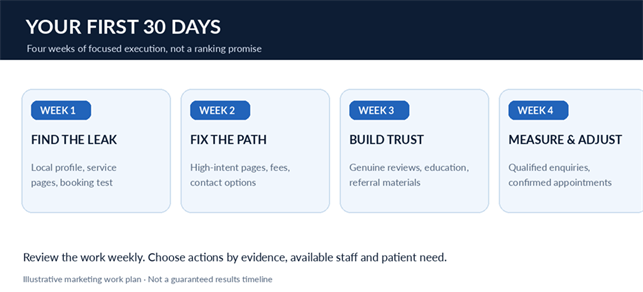
A month is enough to establish a baseline, fix obvious obstacles and test a small, consistent workflow. It is not enough to promise a particular ranking or patient volume. Assign one owner per task and keep an evidence log.
| Week | Concrete work | Output you should have |
| 1 — Diagnose | Inspect GBP, top service pages, mobile booking, missed enquiries and main patient questions. | Short priority list and baseline records. |
| 2 — Improve | Update the highest-value service or location page; fix booking friction; clarify truthful fees and first-visit expectations. | A tested page and working enquiry path. |
| 3 — Build trust | Publish one useful patient answer, update genuine profile details, prepare compliant review/referral processes. | Reusable education and staff process. |
| 4 — Measure | Compare qualified calls, submitted enquiries, booked appointments and gaps in tracking. | Decision on what to continue, fix or stop. |
If staff capacity is limited, complete one improvement properly rather than publishing several unfinished campaigns. Protect clinical quality and response times; marketing that creates unanswered enquiries is not helping patients.
Measure Audiology Marketing Results Beyond Clicks and Impressions
Use a simple chain: search visibility → relevant website visit → enquiry → qualified enquiry → confirmed appointment → attended visit. Each is a different outcome with different data limitations. Google Search Console shows search visibility and clicks, not whether a patient received care; analytics can capture certain website actions, but not every telephone or in-person booking.
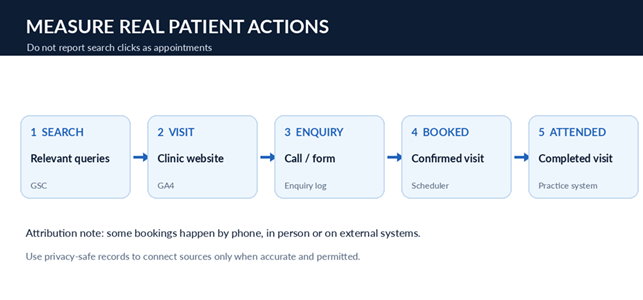
Example only, not SEO Findings performance: if a page gets 200 relevant visits, 12 enquiries, 7 qualified enquiries and 4 confirmed appointments, those figures answer four different questions. The enquiry rate is 6% of visits; the booked-appointment rate is 2% of visits. Neither figure proves whether those appointments were attended.
For a small clinic, a monthly spreadsheet with enquiry date, broad source category, service requested and booking status may be more useful than an elaborate dashboard. Avoid recording medical details in marketing tools. With consent and appropriate systems, compare comparable periods and watch for seasonality or changes in call handling.
Audiology Marketing for Google Search and AI Overviews
AI-generated search answers can summarize general hearing-care questions, but there is no separate shortcut that guarantees a citation in Google AI Overviews or AI Mode. Google says the foundations remain crawlable, indexable, helpful content; technically eligible pages can still be omitted from any given result.
For a clinic, the practical response is to publish clear, verifiable facts about actual services and locations. Answer a patient’s question before adding promotion. Attribute clinical statements to reliable sources, identify qualified practitioners accurately, keep contact details current, add descriptive images and captions, and link related pages so people can continue the task.
Avoid publishing machine-generated medical claims, invented patient stories, fake expertise or “AI visibility guaranteed” offers. Review how the practice appears for relevant questions, but do not treat one AI answer as a reliable or permanent ranking metric.
Compliance Checks Before Launching Hearing Aid Marketing Campaigns
Healthcare marketing needs more care than an ordinary local-business campaign. Before publishing a claim or using patient information, the clinic should have the appropriate clinical and legal staff review it.
- Reviews: request honest feedback without incentives, filtering for only positive reviewers or disclosing health information publicly.
- Patient information: distinguish treatment communications from marketing; follow HIPAA where applicable and any other relevant local privacy rules.
- Hearing aid claims: accurately distinguish FDA-regulated OTC products from prescription options and do not present individual treatment recommendations as universal.
- Paid media: follow Google’s restrictions on sensitive health-related personalization and make landing-page statements match the actual service.
- Accessibility: provide readable text, captions, usable forms and more than one reasonable route to contact the clinic.
This article is marketing education, not medical or legal advice. Rules differ across countries and may change; US-specific references should not be copied unchanged into non-US clinic materials.
When Should a Hearing Clinic Get Professional SEO Help?
Basic updates—correct hours, a clearer booking button, accurate service information—may be handled in-house. A deeper review can be useful when several locations overlap in search, important services are not being discovered, crawl or indexing problems persist, or the team cannot connect search demand with enquiries.
SEO Findings offers hearing aid SEO services for audiologists and clinics. The first step is a high-level review of the public website and its visible issues; detailed account analysis, a complete audit and implementation are separately scoped paid work. No ranking or appointment guarantee is made.
To start, provide your clinic website, real location(s), services you want patients to find and the main problem you have observed. Do not share patient records or sensitive medical details in an SEO enquiry. Request a free initial SEO review — use the existing SEO Findings contact form.
Audiology Marketing Ideas: The Best Next Step
Pick the one problem that is costing your clinic the most useful patient contact, establish a reliable baseline and fix that problem first. If your practice is hard to discover, work on legitimate local visibility. If people arrive but hesitate, explain the service and the booking process. If calls are missed, improve follow-up before buying more traffic. Then measure confirmed appointments as carefully as clicks. That is a more practical growth plan than launching every marketing channel at once.