
The best window cleaning keywords are not simply the searches with the biggest numbers. They are the terms that describe work your business actually provides, in locations you can serve, for people who are likely to request a quote. A cleaner specializing in storefront routes should not build the same keyword plan as a residential-only operator or a company equipped for multi-story commercial buildings.
Below you will find a dated US keyword list, a way to separate service-buying searches from DIY and product searches, and a practical method for assigning keyword groups to the right website pages. You can use the method in other countries, but you must check local demand rather than applying US search volumes everywhere.
Research note: The search-volume and difficulty figures below are Semrush US monthly estimates from the dataset supplied to SEO Findings, dated 15 November 2026. They are not guaranteed traffic, enquiries or rankings. The primary informational query “window cleaning keywords” shows 320 estimated US searches per month, 400 globally and an 8% Semrush difficulty score.
Best Window Cleaning Keywords at a Glance
Start with the service and local terms below. The first question is not “How many searches does it get?” but “Would a person using this term be a suitable customer for my business?”
| Keyword | US searches/mo | Semrush KD | Likely need | Best website destination |
| window cleaning near me | 60,500 | 43% | Find a local provider | Relevant local homepage/service page + eligible Business Profile |
| window cleaning services | 40,500 | 21% | Hire a cleaning service | Main service page or homepage |
| window cleaning company | 27,100 | 43% | Compare providers | Relevant company/service page |
| commercial window cleaning | 12,100 | 5% | Hire a commercial contractor | Commercial service page |
| residential window cleaning | 6,600 | 12% | Hire for a home | Residential service page |
| commercial window washing | 6,600 | 19% | Commercial provider | Often grouped with commercial cleaning |
| high rise window cleaning | 2,400 | 10% | Specialist high-access service | Specialist page only if genuinely offered |
| window cleaning prices | 880 | 9% | Understand costs | Helpful pricing guidance or quote page |
| how much does window cleaning cost | 480 | 23% | Research price before booking | Pricing explanation / informative guide |
| storefront window cleaning | 390 | 1% | Recurring storefront service | Storefront page when offer differs |
| post construction window cleaning | 210 | 4% | Post-build cleaning need | Specialist page if offered; inspect actual SERP |
Notice the difference between commercial window cleaning (12,100 US searches) and storefront window cleaning (390). The first is broader; the second could be more relevant to a company seeking predictable storefront rounds. Conversely, a high-rise query is irrelevant to a company without suitable skills, capacity and safety arrangements. Volume does not settle that decision.
Choose Keywords Based on the Jobs You Want
Start with services, margins and service area
Write down every cleaning service you currently sell, the property types you serve and the locations you can reach reliably. Then identify which work is commercially attractive after travel, labor, equipment and sales effort. For some operators that may be recurring shopfront work; for others it may be larger homes or annual commercial contracts. There is no universal “most profitable” category.
A useful question raised in a Window Cleaning Resource discussion is whether keyword planning should start with the business’s profitable services rather than a list supplied by an SEO tool. That discussion is industry perspective from 2012, not contemporary market-volume evidence.
Separate hiring, research and product intent
| Search example | Probable intent | What a cleaner should do |
| window cleaners near me | Find a nearby business | Make the relevant service and coverage clear |
| commercial window cleaning | Compare commercial providers | Explain capability, scope and quoting |
| window cleaning prices | Research cost | Answer pricing factors and next-step requirements |
| how to clean windows without streaks | DIY instruction | Optional guide; not a primary booking page |
| window cleaning squeegee | Shopping for equipment | Do not treat as a cleaning-service lead |
A cleaning company can publish useful DIY advice, but it should not assume a do-it-yourself reader will convert into a cleaning customer. The same warning applies to equipment searches and window-cleaning jobs: they may produce impressions without bringing suitable quote enquiries.
Apply a simple five-part priority test
- Service fit: do we really provide this work at an acceptable standard?
- Buyer fit: does the query suggest a person seeking our service rather than supplies or instructions?
- Location fit: can we serve the searcher’s area efficiently and truthfully?
- Search competition: what page types appear for that query in the actual target city?
- Business value: would the potential job or recurring relationship justify the work needed to earn visibility?
Use this sequence as a screening method rather than an invented numerical lead score. A low-difficulty keyword is not a shortcut if the business cannot fulfil the job.
Worked decision: four searches, one real-world service constraint
Consider a hypothetical business that cleans residential windows and ground-floor storefronts within its genuine service area but does not undertake high-rise work. The table uses real Semrush US keyword estimates, while the business assumptions and priority decisions are editorial examples—not client research or measured enquiries.
| Search term | US searches/mo | Would this business target it? | First sensible action |
| window cleaning near me | 60,500 | Yes, but results depend heavily on location | Improve local homepage/service information and eligible Business Profile |
| storefront window cleaning | 390 | Yes, good fit for its recurring offer | Describe storefront schedules, routes and how to request a quote |
| commercial window cleaning | 12,100 | Selectively: only for buildings it can actually service | Explain ground-floor commercial scope; do not imply tower access |
| high rise window cleaning | 2,400 | No—business does not provide high-access work | Exclude from service targeting; do not create a misleading page |
The lesson is not that a 390-search phrase always outranks a 60,500-search phrase in value. It is that service match is a gate, not a bonus point. A very large search market does not make a service the business cannot deliver worth targeting. For the remaining candidates, inspect the local results and real enquiry data before deciding whether to improve an existing page or build a distinct one.
Window Cleaning Keywords by Service Type
Local and “near me” searches
Queries such as “window cleaning near me” and “window cleaning company near me” typically ask for a real provider accessible to the searcher. Your site should state service coverage, show a clear quote route and explain what is included. Eligible businesses should keep their Google Business Profile accurate; Google requires genuine business and service-area details, not virtual locations created to capture keyword combinations.
Do not create a dedicated page named “near me” merely to repeat the phrase. Google interprets these searches in a geographic context. Where your website and Business Profile each serve a different role, keep their business details consistent and honest.
Residential window cleaning keywords
“Residential window cleaning” (6,600 US monthly searches) and “residential window washing” (1,300) describe closely related needs. A residential page should clarify interior versus exterior work, window screens and tracks where offered, property access, how quotes are prepared, and which towns are served. Those questions are more useful than repeating the word “residential” in every heading.
If you only clean exterior windows, say so. If a first-floor-only service is the actual limit, avoid wording that suggests unrestricted multi-story work. Accurate scope is both a conversion advantage and a trust signal.
Commercial window cleaning keywords
“Commercial window cleaning” (12,100), “commercial window washing” (6,600) and “commercial window cleaning services” (1,300) all point toward businesses needing a provider. They may belong on one substantive commercial page when the SERP and offered service overlap. Useful content might cover office and retail building types, site surveys, scheduling, insurance documentation where applicable, and the information a facilities manager needs to request a quote.
A company seeking small office contracts should not automatically pursue high-rise work. Commercial is a buyer category; it is not proof that all commercial jobs share the same capability requirements.
Storefront and recurring route keywords
“Storefront window cleaning” has 390 estimated US monthly searches in the supplied dataset. It may be attractive for companies building repeatable routes because the page can explain cleaning frequency, opening-hour access, service boundaries and recurring quote arrangements. Whether this deserves a separate URL depends on how different the storefront offer really is from the wider commercial service.
Specialist and post-construction work
“High rise window cleaning” (2,400) should only be targeted by suitably qualified and equipped providers. “Post construction window cleaning” (210) may involve an additional set of customer expectations about debris, protective films and potential glass damage. Confirm exactly what work is safe, insured and offered before publishing technical promises. An SEO article cannot substitute for an occupational safety assessment.
Pricing and estimate keywords
“Window cleaning prices” (880) and “how much does window cleaning cost” (480) typically signal someone evaluating a purchase. A useful pricing section explains which variables affect a quote: pane count, accessibility, interior/exterior scope, property size and cleaning frequency. Do not publish fabricated national average fees. If the business uses site surveys or custom quotes, describe that process clearly instead of promising an exact price you cannot substantiate.
Map Each Keyword Group to the Right Website Page
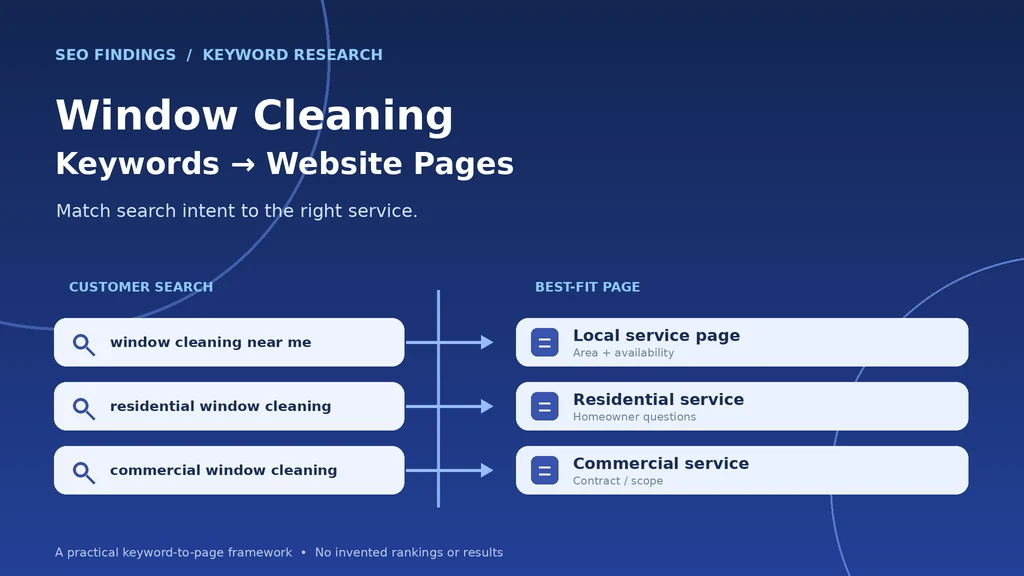
A keyword list becomes useful only when every meaningful search intent has a suitable destination. One business might handle broad local demand on the homepage; another may need separate residential and commercial pages. Search results, actual offers and the existing site structure determine the choice.
| Keyword cluster | Suggested destination | Reason to keep or separate |
| General local window cleaning | Homepage or principal service page | Covers the core local service |
| Residential / home window washing | Residential service page, if distinct | Homeowner scope and quote questions |
| Commercial / office window cleaning | Commercial service page | Different buyer requirements and capability proof |
| Storefront / routine shopfront cleaning | Storefront page only if offer is meaningfully distinct | Recurring routes, access and frequency |
| Town-specific window cleaning | Genuine local page only when warranted | Real local coverage and useful area details |
| Window cleaning cost / prices | Helpful pricing page or subsection | Budget questions before contacting |
| High-rise / post-construction cleaning | Specialist service page only if offered | Distinct work, risks and service proof |
| How to clean windows without streaks | Optional educational guide | DIY intent; not a core booking page |
Keep near-identical keywords on one strong page
A residential cleaner does not need separate pages for “residential window cleaning,” “home window cleaning” and “residential window washing” simply because the phrases differ. Compare what the searcher expects and what the actual results show. If all three searches would reasonably be answered by the same offer, consolidate them into one helpful page.
Publish location pages only when they help people
A separate town page can be justified when the company genuinely serves that area and can provide distinct, useful evidence: coverage details, meaningful local access notes, relevant services or authentic local work. Mass-producing interchangeable pages by replacing town names is not a sound strategy. Google’s spam policies describe doorway abuse aimed at similar search queries.
This mapping is for a window cleaning company’s website. It is not a recommendation for SEO Findings itself to target residential cleaning or commercial cleaning customer terms with separate consultancy articles. SEO Findings serves business owners seeking SEO guidance; its window cleaning SEO service page addresses the commercial consultancy intent.
Worked Keyword Plans for Three Business Models
The following examples are hypothetical planning scenarios, not client projects or performance case studies. Their purpose is to show why an identical keyword list can produce very different priorities.
Example 1: A residential-only owner-operator
Situation: A solo cleaner serves one city and nearby neighborhoods, with no commercial crew. Plan: Improve the main local service page first, then strengthen one residential page with quote details, real photos, service limitations and contact options. Do not spend the first month writing high-rise pages. The most valuable first measurement is whether local residential searches reach a useful page and generate enquiries within the service area.
Example 2: A compact storefront route business
Situation: A small team offers recurring shopfront cleaning in an established route. Plan: Give storefront work a visibly defined offer, explain the covered districts and frequency options, and provide a route-specific quote form. Compare the storefront SERP with the broader commercial search before deciding whether one or two pages are needed. Measure suitable recurring-route enquiries, not just all contact clicks.
Example 3: A mixed residential and commercial company
Situation: A business serves homes, retail units and small office buildings, but does not offer high-rise access. Plan: Use a principal local page plus separate residential and commercial pages if distinct customer tasks justify them. Link naturally between relevant services. Do not add a high-rise page to chase its volume because the business cannot deliver that service.
How to Find the Best Keywords in Your Own Market
Build a candidate list from real customer language
Collect the phrases customers use in quote forms, phone enquiries, emails and search-console queries. Then combine a real service with the actual town or area you cover. For example, “storefront window cleaning in [actual service town]” is a research candidate, not proof that Google records measurable monthly searches for that exact combination.
Inspect the local results before choosing a page
Run a representative query in the target market and record which results appear: service-company pages, a local pack, directories, articles, or mixed results. Review what strong competitors explain about scope, service area and quoting. The SERP matters more than assigning a generic difficulty score to every city.
Google describes local ranking in terms of relevance, distance and prominence. An eligible service-area company can improve accuracy and usefulness but cannot force Google to show it for an unrelated location.
Do not transfer US metrics directly to other countries
The figures in this guide are estimated for the United States. Readers in the United Kingdom may search for “window cleaners” or “window cleaning” in different proportions, while terminology, competitors and quote conventions vary across markets. A global company should research each target country separately; there is no single interchangeable global difficulty score.
Keywords to Exclude, Deprioritize or Treat Differently
A large exported keyword list often contains many terms that are real searches but poor candidates for a service business. Filter them before estimating opportunity.
| Term or category | Why it can mislead | Recommended treatment |
| Window cleaning robots, squeegees, solutions | Often product-shopping intent | Exclude unless selling products |
| How to clean windows without streaks | Primarily instruction-seeking | Optional helpful blog, not lead page |
| Window cleaning jobs / salary | Recruitment intent | Separate careers page only if hiring |
| Window cleaning business startup | Entrepreneurship intent | Usually outside local-service lead strategy |
| Unserved city + service | Cannot truthfully fulfil the job | Do not create a misleading location page |
| Gutter / roof / solar panel cleaning | Different service scope | Target only when genuinely provided |
These categories are editorial classifications; actual individual-query SERPs may contain mixed intent.
A keyword tool may report a nonzero volume for a phrase that should never become its own landing page. Removing unsuitable keywords is an important part of research, not wasted work.
A Repeatable Keyword Research Workflow
- List real services, priority property types and genuine service areas.
- Collect candidates from Search Console, customer enquiry language and a keyword research tool.
- Review the market and tool date; record estimates without adding overlapping volumes together.
- Check the live SERP for the most important terms and classify buyer intent.
- Assign each useful cluster to an existing URL where possible; plan a new page only for a separate user need.
- Improve the page to answer the questions a suitable prospect actually has.
- Record a baseline and review enquiries alongside search visibility.
Finding the right keywords is only one part of attracting customers. Once you understand what people search for, explore our guide on how to get window cleaning leads to compare organic, paid and referral-based methods for generating enquiries and booked jobs.
For a practical general explanation of why keyword fit matters more than chasing any available volume, see how to improve website rankings without spending on ads. An accessible planner can be as simple as a spreadsheet with columns for keyword, country, search estimate, intent, offered service, page owner, next action and research date.
Measure Useful Outcomes, Not Just Impressions
| Stage | What it answers | What it does not prove |
| Search Console impressions | Was the page shown for relevant queries? | That someone visited |
| Organic clicks and sessions | Did visitors arrive from search? | That a reader needs a quote |
| Received forms / calls | Did an enquiry reach the business? | That the lead is qualified |
| Qualified enquiries | Does the request match service and area? | That the job was won |
| Booked jobs or recurring contracts | Did the business confirm the result? | That SEO alone caused every outcome |
For example, if a pricing guide earns impressions but enquiries mostly ask for areas you do not serve, refine the page’s service-area explanation. If a commercial page earns the right visits but produces incomplete requests, improve the commercial quote path. If the query itself points to equipment shopping, changing the button color will not fix the intent mismatch.
SEO research should be reviewed when the offer, market, competitive results or customer demand changes. Ongoing SEO work is about diagnosing changes and improving decisions, not rewriting a keyword list every week.
Window Cleaning Keyword Planning Checklist
- I can name the actual services and property types I want to sell.
- I have separated hiring terms from DIY, equipment, training and job-search terms.
- My keyword estimates show a country, provider and research date.
- I checked the leading page types for important searches in my target city.
- Related queries are grouped on one useful URL unless customers need distinct answers.
- Location pages represent real service coverage rather than copied town-name variants.
- The website explains service scope, availability, credibility and the quote process.
- I can measure impressions, received enquiries, qualified leads and bookings separately.
A good result from this exercise is not a spreadsheet with hundreds of rows. It is a short, prioritized plan explaining what to improve, where, and for which customer.
The practical takeaway: choose queries that match the services you can deliver, group similar searches on a useful page, then verify the results in the actual market. A short, accurate keyword map is more valuable than a long list with no owner or next action.
Research Methods and Data Limitations
SEO Findings reviewed a user-supplied Semrush US keyword export dated 15 November 2026, supporting competitor URL-level exports dated 13–14 November 2026, a Google US desktop result screenshot and accessible competing pages. Keyword estimates in this article are from that Semrush export; classification and page recommendations are editorial analysis. Competing resources from SERPWARS, SEO Counselors and GetPhound offer other keyword-list approaches; their numbers and examples are not combined into one artificial metric. None of the examples on this page should be interpreted as actual ranking or lead results for a window-cleaning client.
Google’s people-first content guidance emphasizes usefulness and transparent context. Its AI Search documentation also says no special AI markup is required for inclusion in AI Overviews or AI Mode. Clear tables and answers here exist to help readers, not to guarantee AI citations.
Need Help Reviewing Your Window Cleaning Keyword Plan?
If you already have a cleaning business website but are unsure which customer searches each page should answer, SEO Findings’ window cleaning SEO services can help assess page targeting and enquiry paths. The free initial review uses your public site, real services and target locations to identify a sensible starting point; detailed audits, content production and implementation are separately scoped and quoted before work begins. If you would like a second opinion, start with the relevant service page and share your website, core services and genuine service areas through the enquiry option there. A useful review should identify specific issues and next steps rather than promise a ranking position.